
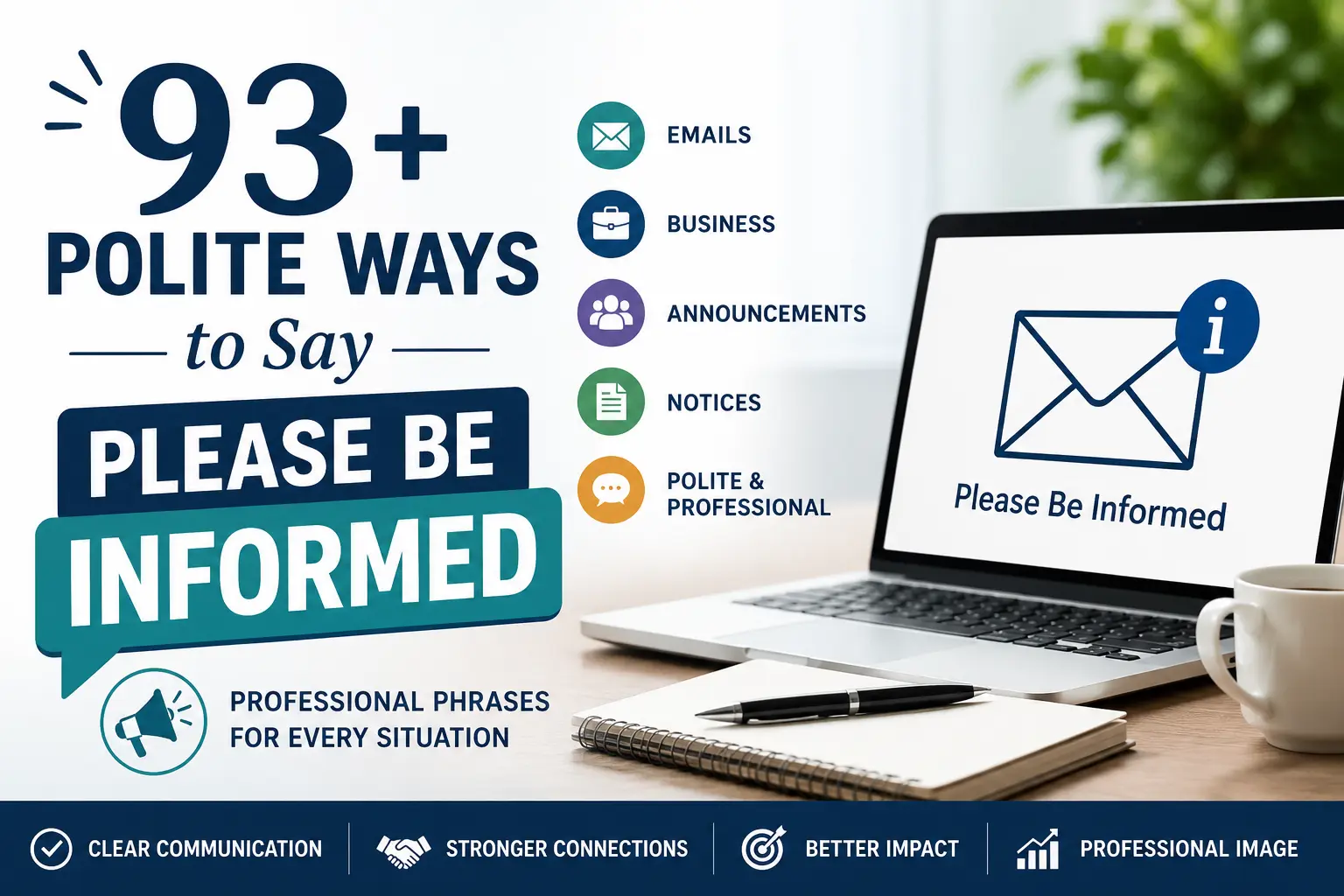
Clear and respectful communication is the foundation of every professional relationship. While “please be informed” is a common phrase used in emails, letters, and official notices, relying on it too often can make your writing feel repetitive or overly formal. Choosing more natural alternatives helps your message sound warmer, more engaging, and better suited to different audiences.
Whether you’re notifying a client about a policy update, informing colleagues of a schedule change, or sharing important news with customers, using varied expressions improves readability and strengthens your communication. The right wording can create a more positive impression while maintaining professionalism. In this guide, you’ll discover 93+ polite ways to say “please be informed”, along with meanings, tones, examples, and practical tips to help you communicate confidently in both formal and everyday situations.
What Does “Please Be Informed” Mean?
The phrase “please be informed” is a formal expression used to notify someone about important information or an upcoming update. It politely signals that the reader should pay attention to the message because it contains relevant details.
Its tone is generally respectful, official, and professional. It frequently appears in business emails, corporate announcements, legal documents, academic notices, and customer communications. Although it remains appropriate in many situations, modern business writing often favors friendlier alternatives that sound more conversational while remaining professional.
When to Use It
You can use this phrase in many communication settings, including:
- Business emails announcing updates.
- Company policy notifications.
- Customer service announcements.
- School or university notices.
- Legal or compliance communications.
- Project status updates.
- Official speeches and presentations.
Examples:
- Please be informed that tomorrow’s meeting has been rescheduled.
- Please be informed that our office will remain closed on Friday.
- Please be informed that your application has been approved.
In casual conversations, however, softer alternatives usually sound more natural.
Is It Polite or Professional?
Yes. “Please be informed” is both polite and professional. It communicates information respectfully without sounding demanding.
However, because it is highly formal, it may seem distant in friendly emails or modern workplace communication. Many organizations now encourage clearer, more approachable language that builds stronger relationships while maintaining professionalism.
Replacing it with a suitable alternative can make your writing sound more thoughtful, personable, and reader friendly.
93+ Polite Ways to Say Please Be Informed
1. Please note
Meaning: Draws attention to important information.
Tone: Professional
Example: “Please note that the deadline has been extended until Friday.”
Explanation: One of the most common professional alternatives.
Purpose: Highlights key details without sounding overly formal.
2. Kindly note
Meaning: Politely asks readers to notice something.
Tone: Courteous
Example: “Kindly note that parking is unavailable today.”
Explanation: Frequently used in formal correspondence.
3. Please be advised
Meaning: Official notification.
Tone: Formal
Example: “Please be advised that maintenance will begin tonight.”
Explanation: Suitable for legal or corporate communication.
4. We would like to inform you
Meaning: Politely introduces information.
Tone: Warm professional
Example: “We would like to inform you that your request has been approved.”
Explanation: Sounds more personal than the original phrase.
5. This is to inform you
Meaning: Announces important news.
Tone: Formal
Example: “This is to inform you that your subscription has expired.”
Explanation: Common in official letters.
6. Please be aware
Meaning: Encourages awareness.
Tone: Friendly professional
Example: “Please be aware that traffic delays are expected.”
Explanation: Useful for alerts.
7. For your information
Meaning: Shares helpful details.
Tone: Neutral
Example: “For your information, the report has been finalized.”
Explanation: Excellent for internal emails.
8. Just to let you know
Meaning: Casual notification.
Tone: Friendly
Example: “Just to let you know, the meeting starts at 10 AM.”
Explanation: Great for informal communication.
9. I’d like to let you know
Meaning: Personal notification.
Tone: Warm
Example: “I’d like to let you know that your package has shipped.”
Explanation: Creates a conversational tone.
10. Please keep in mind
Meaning: Reminds readers.
Tone: Friendly
Example: “Please keep in mind that registration closes tomorrow.”
Explanation: Ideal for reminders.
11. Please remember
Meaning: Gentle reminder.
Tone: Friendly
Example: “Please remember to submit your timesheet today.”
Explanation: Works well in team communication.
Purpose: Encourages action politely.
12. We wish to notify you
Meaning: Formal notification.
Tone: Professional
Example: “We wish to notify you of upcoming changes.”
Explanation: Suitable for official announcements.
13. Allow us to inform you
Meaning: Respectful introduction.
Tone: Formal
Example: “Allow us to inform you about our new policy.”
Explanation: Appropriate for business letters.
14. Please take note
Meaning: Highlights importance.
Tone: Professional
Example: “Please take note of the revised schedule.”
Explanation: Direct yet courteous.
15. Be aware that
Meaning: Warns or informs.
Tone: Neutral
Example: “Be aware that services may be delayed.”
Explanation: Best for updates requiring attention.
16. Keep in mind
Meaning: Encourages remembering.
Tone: Friendly
Example: “Keep in mind that seating is limited.”
Explanation: Common in everyday communication.
17. We are pleased to inform you
Meaning: Shares good news.
Tone: Positive
Example: “We are pleased to inform you that you have been selected.”
Explanation: Perfect for approvals.
18. We regret to inform you
Meaning: Announces unfortunate news.
Tone: Formal
Example: “We regret to inform you that the event has been canceled.”
Explanation: Used for disappointing updates.
19. You should know
Meaning: Shares useful information.
Tone: Casual
Example: “You should know the office opens earlier tomorrow.”
Explanation: Friendly conversations.
20. I’d like to notify you
Meaning: Announces information.
Tone: Professional
Example: “I’d like to notify you about the upcoming inspection.”
Explanation: Sounds personal.
21. Please understand
Meaning: Requests understanding.
Tone: Respectful
Example: “Please understand that delays are unavoidable.”
Explanation: Useful during difficult situations.
22. You may wish to know
Meaning: Offers information politely.
Tone: Warm
Example: “You may wish to know that registration is now open.”
Explanation: Less direct.
23. We would like to notify you
Meaning: Formal notice.
Tone: Professional
Example: “We would like to notify you of schedule changes.”
Explanation: Appropriate for announcements.
24. We want to make you aware
Meaning: Raises awareness.
Tone: Friendly
Example: “We want to make you aware of system maintenance.”
Explanation: Sounds approachable.
25. We are writing to let you know
Meaning: Introduces news.
Tone: Warm professional
Example: “We are writing to let you know about your appointment.”
Explanation: Excellent for emails.
26. This serves as notice
Meaning: Official notification.
Tone: Formal
Example: “This serves as notice of policy revisions.”
Explanation: Common in legal writing.
27. Take note that
Meaning: Draws attention.
Tone: Formal
Example: “Take note that fees have changed.”
Explanation: Concise and direct.
28. It is important to note
Meaning: Highlights significance.
Tone: Professional
Example: “It is important to note that refunds are limited.”
Explanation: Emphasizes key information.
29. Please consider this notice
Meaning: Official communication.
Tone: Formal
Example: “Please consider this notice effective immediately.”
Explanation: Best for policy changes.
30. We wish to advise
Meaning: Offers information.
Tone: Formal
Example: “We wish to advise all employees of new procedures.”
Explanation: Traditional business language.
31–94. Additional Polite Alternatives
- Please take notice
- We are notifying you
- Kindly be aware
- This is a friendly reminder
- We wanted to let you know
- Here is an important update
- Please review the following information
- We are sharing this information with you
- Please see the update below
- We would like to bring this to your attention
- This announcement concerns
- Please review this notice
- We are pleased to share
- We are writing regarding
- Here is what you need to know
- Please review carefully
- We encourage you to note
- This message is to notify you
- Please read the following carefully
- We invite your attention to
- Please review the details below
- We would like to highlight
- Allow us to share
- Important information follows
- Please be mindful that
- We would appreciate your attention
- Take a moment to review
- Please review this update
- We have an important announcement
- We wish to bring to your attention
- This update concerns
- You are requested to note
- Please acknowledge the following
- We are happy to announce
- We respectfully inform you
- Please familiarize yourself with
- Please review the attached information
- We are contacting you regarding
- This communication is intended to inform you
- We trust you will note
- Please take this into account
- Allow us to notify you
- This notice is for your attention
- We are providing this update
- We are reaching out to inform you
- Please observe the following
- We kindly ask you to note
- This serves as an update
- Please review this announcement
- Please be conscious that
- We hope this keeps you informed
- Kindly be advised
- This information is provided for your reference
- We are issuing this notice
- You may find this helpful to know
- This is an important reminder
- We thought you should know
- Please stay informed that
- We are pleased to notify you
- Please review the latest update
- This is to keep you informed
- Please accept this notification
- We felt it important to inform you
- Consider this an official update
Conclusion
Using alternatives to “please be informed” allows you to communicate with greater clarity, warmth, and professionalism. Whether you’re writing a formal business email, sending a customer update, or sharing information with colleagues, choosing the right expression helps your message feel more natural and engaging. The 93+ alternatives in this guide give you plenty of options for every communication style. Experiment with different phrases based on your audience and purpose, and you’ll create messages that are both effective and memorable.
Discover more.
professional synonyms for kindly request