
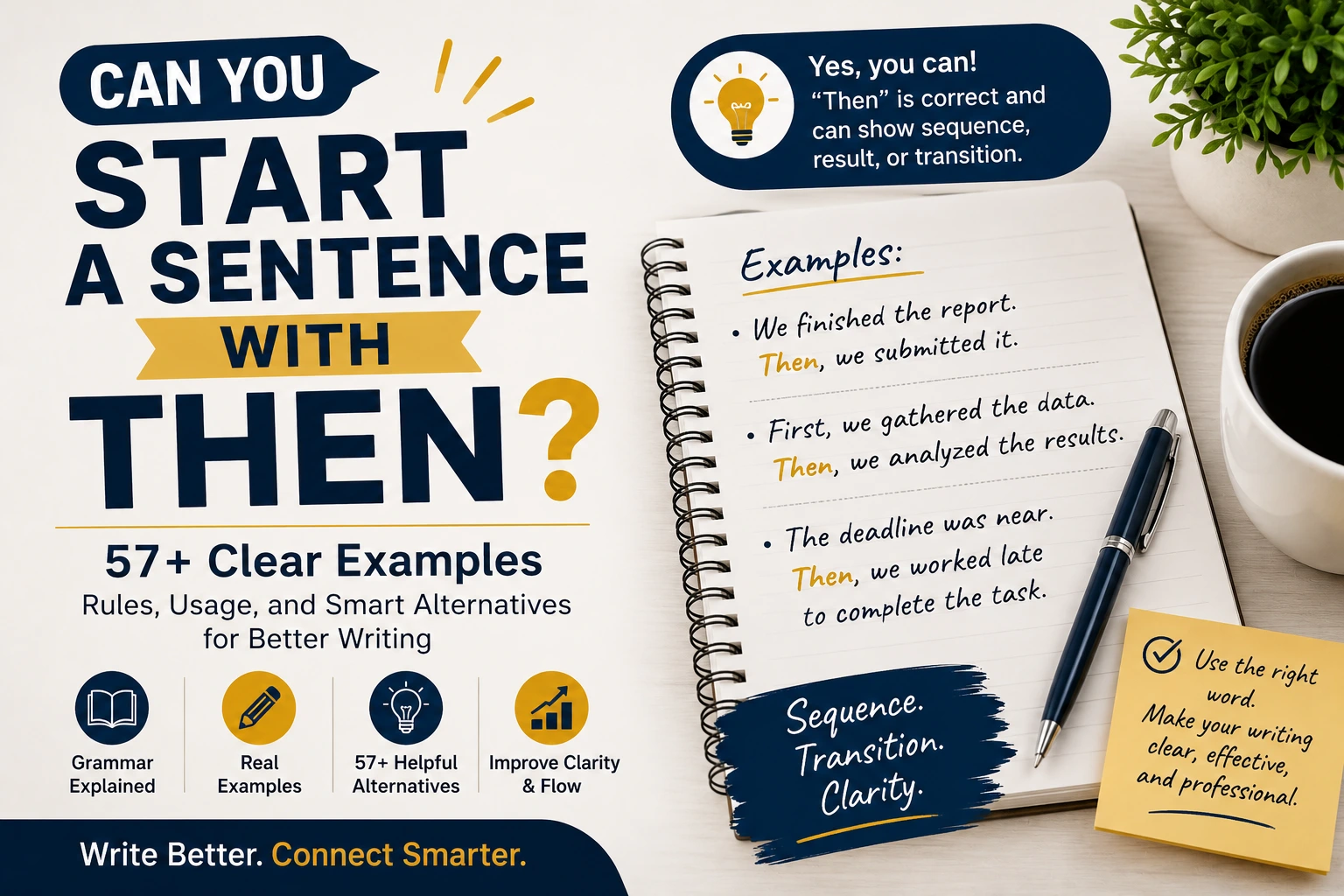
Can you start a sentence with “then”? Absolutely. Starting a sentence with “then” is grammatically acceptable, and it can be an effective way to show sequence, consequence, transition, or a change in thought. Despite this, many writers hesitate to use “then” at the beginning of a sentence because they have heard that certain words should not start sentences. In reality, English offers considerable flexibility when it comes to sentence structure. The key is understanding how “then” functions within the sentence and choosing the right context for it. Whether you are writing an email, telling a story, explaining instructions, or creating academic content, beginning a sentence with “then” can make your writing flow naturally. In this guide, we will explore when and how to use “then” at the beginning of a sentence and examine 57+ useful alternatives.
What Does “Can You Start a Sentence With Then?” Mean?
The question “Can you start a sentence with then?” asks whether the word “then” can grammatically appear at the beginning of a sentence.
The answer is yes. There is no general grammar rule that prohibits starting a sentence with “then.” Its acceptability depends on how the word functions and whether the resulting sentence is clear and logical.
“Then” can serve several purposes in English.
It can indicate sequence.
“Then, we reviewed the final report.”
It can indicate consequence.
“The deadline was approaching. Then, we decided to work overtime.”
It can introduce the next event in a story.
“Then, something unexpected happened.”
It can also emphasize a result or conclusion.
“Then, we have no reason to delay the decision.”
The tone is generally neutral and flexible. In narrative writing, it can sound conversational, while in instructions and professional communication, it can clearly indicate the next step.
When to Use “Then” at the Beginning of a Sentence
Starting a sentence with “then” can be useful in several writing and speaking situations.
To Show Sequence
Use “then” when describing events in the order they happen.
“First, complete the application. Then, submit the required documents.”
This is especially useful in instructions, tutorials, and explanations.
To Describe Events in a Story
“Then” can smoothly move a reader from one event to another.
“We reached the station. Then, the train arrived.”
This makes narrative writing easy to follow.
To Show a Consequence
“Then” can introduce what happens as a result of something previously mentioned.
“If the information is accurate, then we can proceed with the proposal.”
In Workplace Communication
“Then” can help organize steps during meetings, presentations, and emails.
“We will review the budget first. Then, we can discuss the timeline.”
In Casual Conversation
Starting with “then” is extremely common in everyday speech.
“Then, what happened?”
In Academic Writing
It can be used when the logical sequence is important, although formal academic writing may sometimes benefit from alternatives such as “subsequently,” “thereafter,” or “next.”
Is Starting a Sentence With “Then” Polite or Professional?
Yes. Starting a sentence with “then” is neither inherently informal nor unprofessional. The appropriateness depends on how it is used.
For example:
“Then, we will proceed with the next stage.”
This sentence is perfectly suitable for a professional setting.
However, repeatedly beginning sentences with “then” can make formal writing feel simplistic or repetitive. In more polished writing, you can vary your transitions with words such as “next,” “subsequently,” “afterward,” “therefore,” or “as a result.”
It is also important to distinguish between grammatical correctness and stylistic quality. A sentence can be grammatically correct while still sounding repetitive or awkward. Good writing uses transitions strategically rather than mechanically.
1. Next
Meaning: Indicates the following event or step.
Tone: Neutral, clear, professional.
“Next, we will review the final section of the report.”
Short Explanation: Use “next” when describing a sequence of actions or ideas.
Purpose and Personalization: It is particularly effective in instructions and presentations.
2. Afterward
Meaning: Refers to something that happens later.
Tone: Neutral, polished.
“Afterward, we discussed the results with the team.”
Short Explanation: This works well when describing events that happen after a particular point.
3. Subsequently
Meaning: Indicates that something happened afterward.
Tone: Formal, academic, professional.
“Subsequently, the committee approved the proposal.”
Short Explanation: Choose this for formal reports, academic writing, and business documents.
4. After That
Meaning: Refers to the event immediately following a previous one.
Tone: Natural, conversational.
“After that, we returned to the office.”
Short Explanation: This is an easy and natural alternative for everyday writing.
5. Later
Meaning: Indicates that something happens at a subsequent time.
Tone: Neutral, conversational.
“Later, we discovered that the information had been updated.”
Short Explanation: Use “later” when the exact sequence is less important than the fact that something happened afterward.
6. Following This
Meaning: Indicates that something occurs after the current event.
Tone: Formal, professional.
“Following this, the team will begin implementation.”
Short Explanation: A strong option for reports, instructions, and workplace communication.
7. Following That
Meaning: Refers to an event that happens after something previously mentioned.
Tone: Professional, neutral.
“Following that, we will finalize the schedule.”
Short Explanation: Useful when referring directly to a previous action.
8. Thereafter
Meaning: From that time onward or after that event.
Tone: Formal, sophisticated.
“Thereafter, all requests must be submitted through the online system.”
Short Explanation: Best suited to formal documents and policies.
9. From There
Meaning: Indicates progression from a particular point.
Tone: Conversational, professional.
“From there, we moved toward the implementation stage.”
Short Explanation: This creates a smooth sense of progression.
10. At That Point
Meaning: Refers to a particular moment in a sequence.
Tone: Neutral, descriptive.
“At that point, we decided to reconsider the strategy.”
Short Explanation: Use this when timing or a specific moment matters.
11. At That Stage
Meaning: Refers to a particular stage of a process.
Tone: Professional, formal.
“At that stage, the project was ready for final review.”
Short Explanation: Particularly useful in project management and business writing.
12. In the Next Step
Meaning: Introduces the following stage in a process.
Tone: Professional, instructional.
“In the next step, we will analyze the available data.”
Short Explanation: Works well in guides, procedures, and educational content.
13. The Next Step Is
Meaning: Clearly introduces what should happen next.
Tone: Professional, direct.
“The next step is to verify the information.”
Short Explanation: Ideal for workplace instructions and planning.
14. Moving Forward
Meaning: Indicates progression into the future.
Tone: Professional, motivational.
“Moving forward, we will prioritize customer feedback.”
Short Explanation: Common in business communication when discussing future actions.
15. From That Point On
Meaning: Indicates what happened after a particular moment.
Tone: Narrative, neutral.
“From that point on, the team followed a different strategy.”
Short Explanation: Useful for storytelling and describing changes over time.
16. Once That Was Done
Meaning: Indicates what happened after a previous task was completed.
Tone: Natural, instructional.
“Once that was done, we submitted the final application.”
Short Explanation: Particularly useful for explaining procedures.
17. Once Completed
Meaning: Indicates what happens after a task is finished.
Tone: Formal, concise.
“Once completed, the form should be submitted to the administrator.”
Short Explanation: Effective in professional instructions and written procedures.
18. Upon Completion
Meaning: Indicates an action that occurs after something has been completed.
Tone: Formal, professional.
“Upon completion, the report will be reviewed by management.”
Short Explanation: A polished choice for formal documents.
19. Afterward, We
Meaning: Clearly signals the next action by a particular subject.
Tone: Neutral, conversational.
“Afterward, we discussed the feedback with our supervisor.”
Short Explanation: This is useful when maintaining a clear narrative sequence.
20. In the Meantime
Meaning: Refers to something happening during the period before another event.
Tone: Neutral, professional.
“In the meantime, we can prepare the necessary documents.”
Short Explanation: Use this when two actions overlap in time.
21. Meanwhile
Meaning: Indicates something happening at the same time.
Tone: Neutral, polished.
“Meanwhile, the finance team was reviewing the figures.”
Short Explanation: This is a useful alternative when the relationship is simultaneous rather than sequential.
22. Soon After
Meaning: Indicates that something happened shortly after another event.
Tone: Narrative, natural.
“Soon after, the company announced the final decision.”
Short Explanation: Ideal for storytelling and chronological descriptions.
23. Shortly Afterward
Meaning: Indicates that something happened a short time later.
Tone: Formal, descriptive.
“Shortly afterward, the meeting came to an end.”
Short Explanation: Adds precision to chronological writing.
24. Not Long After
Meaning: Indicates that an event occurred relatively soon afterward.
Tone: Conversational, narrative.
“Not long after, we received confirmation.”
Short Explanation: Works well in stories and informal explanations.
25. Eventually
Meaning: Indicates that something happened after some time.
Tone: Neutral, narrative.
“Eventually, the team reached an agreement.”
Short Explanation: Use this when the result occurs after a period of development rather than immediately.
26. Ultimately
Meaning: Indicates the final result or conclusion.
Tone: Formal, professional.
“Ultimately, the organization decided to adopt the new policy.”
Short Explanation: Better than “then” when emphasizing the final outcome.
27. Finally
Meaning: Indicates the last step or final event.
Tone: Neutral, professional.
“Finally, we presented our recommendations to the board.”
Short Explanation: Ideal for concluding a sequence.
28. At Last
Meaning: Indicates that something finally happened after waiting or difficulty.
Tone: Expressive, narrative.
“At last, the team received the approval it needed.”
Short Explanation: Best when the event follows anticipation or delay.
29. In Turn
Meaning: Indicates that something happens as a consequence or part of a sequence.
Tone: Formal, polished.
“In turn, this improvement increased overall productivity.”
Short Explanation: Particularly useful when showing relationships between events.
30. As a Result
Meaning: Introduces a consequence of something previously stated.
Tone: Formal, professional.
“As a result, the company revised its strategy.”
Short Explanation: Use this instead of “then” when the relationship is cause and effect.
31. Therefore
Meaning: Introduces a logical conclusion.
Tone: Formal, academic, professional.
“Therefore, we recommend extending the deadline.”
Short Explanation: This is more precise than “then” when you are expressing a conclusion.
32. Consequently
Meaning: Indicates a direct result or consequence.
Tone: Formal, academic.
“Consequently, the project required additional resources.”
Short Explanation: Best for analytical and professional writing.
33. For That Reason
Meaning: Explains why a particular conclusion or action follows.
Tone: Professional, explanatory.
“For that reason, we decided to postpone the launch.”
Short Explanation: Use this when you want to emphasize the reason behind the next action.
34. Accordingly
Meaning: Indicates an action taken because of previous information.
Tone: Formal, professional.
“Accordingly, the team revised the project timeline.”
Short Explanation: Excellent for business reports and formal correspondence.
35. As a Consequence
Meaning: Introduces an outcome caused by something earlier.
Tone: Formal, academic.
“As a consequence, the organization adjusted its priorities.”
Short Explanation: Use this when emphasizing cause and effect.
36. With That in Mind
Meaning: Introduces an action or conclusion based on something previously considered.
Tone: Professional, thoughtful.
“With that in mind, we decided to revise the proposal.”
Short Explanation: Useful when transitioning from analysis to a decision.
37. Given This
Meaning: Indicates that the following statement is based on the previous information.
Tone: Formal, analytical.
“Given this, we should reconsider the current approach.”
Short Explanation: Effective in professional recommendations and analytical writing.
38. In Light of This
Meaning: Introduces a response based on newly considered information.
Tone: Formal, professional.
“In light of this, the committee requested additional evidence.”
Short Explanation: Particularly useful in reports and formal discussions.
39. Based on This
Meaning: Indicates that the following action or conclusion relies on previous information.
Tone: Professional, analytical.
“Based on this, we can move to the next phase.”
Short Explanation: A clear alternative for business and academic contexts.
40. From This Point Forward
Meaning: Indicates what will happen from now onward.
Tone: Formal, professional.
“From this point forward, all requests must be documented.”
Short Explanation: Useful when announcing a new procedure or policy.
41. From Now On
Meaning: Indicates a change that begins immediately and continues into the future.
Tone: Direct, conversational.
“From now on, we will review every submission carefully.”
Short Explanation: Suitable for workplace instructions and everyday communication.
42. Going Forward
Meaning: Refers to future actions or decisions.
Tone: Professional, businesslike.
“Going forward, we will communicate updates through email.”
Short Explanation: Common in workplace communication and strategic discussions.
43. Next in Line
Meaning: Indicates the item or action that follows.
Tone: Conversational, professional.
“Next in line is the budget review.”
Short Explanation: Useful for presentations and structured discussions.
44. The Following Step
Meaning: Refers to the action that comes next.
Tone: Formal, instructional.
“The following step is to evaluate the results.”
Short Explanation: A clear alternative when explaining a process.
45. After Completing This
Meaning: Indicates what happens after a current action is finished.
Tone: Neutral, instructional.
“After completing this, proceed to the final section.”
Short Explanation: Useful in tutorials, instructions, and educational writing.
46. After Reviewing the Information
Meaning: Introduces an action that follows a review.
Tone: Professional, specific.
“After reviewing the information, we decided to revise the proposal.”
Short Explanation: More precise than “then” because it explains what occurred first.
47. Once We Have Done That
Meaning: Indicates the next step after completing a particular task.
Tone: Conversational, professional.
“Once we have done that, we can move forward with the implementation.”
Short Explanation: Natural for meetings and spoken explanations.
48. Once We Reach That Stage
Meaning: Refers to a future point in a process.
Tone: Professional, conversational.
“Once we reach that stage, we can evaluate the results.”
Short Explanation: Useful when describing a process that unfolds gradually.
49. At That Time
Meaning: Refers to a particular point in time.
Tone: Neutral, formal.
“At that time, we will review the available options.”
Short Explanation: A good choice when timing is more important than sequence.
50. At the Next Opportunity
Meaning: Refers to the next suitable time.
Tone: Formal, professional.
“At the next opportunity, we will discuss the proposal in greater detail.”
Short Explanation: Useful when the next action does not have a specific scheduled time.
51. In the Next Phase
Meaning: Indicates what will happen during a subsequent stage.
Tone: Professional, structured.
“In the next phase, the team will begin testing.”
Short Explanation: Particularly useful in project management and business writing.
52. During the Next Stage
Meaning: Refers to an action occurring during a later part of a process.
Tone: Formal, professional.
“During the next stage, we will assess the project’s performance.”
Short Explanation: Useful for reports, plans, and presentations.
53. As We Proceed
Meaning: Indicates something that happens while moving forward.
Tone: Professional, polished.
“As we proceed, we will monitor the project’s progress.”
Short Explanation: Excellent for presentations and workplace communication.
54. As We Move Forward
Meaning: Refers to actions or decisions made during future progress.
Tone: Professional, encouraging.
“As we move forward, we will continue to evaluate the results.”
Short Explanation: This works particularly well in business communication.
55. In Due Course
Meaning: At the appropriate or expected time.
Tone: Formal, sophisticated.
“In due course, we will provide further information.”
Short Explanation: Best suited to formal correspondence and professional announcements.
56. Thereupon
Meaning: Immediately or directly after something happens.
Tone: Formal, literary.
“Thereupon, the committee proceeded with the final vote.”
Short Explanation: This is uncommon in everyday conversation but can work in formal or literary writing.
57. At That Moment
Meaning: Refers specifically to the moment being described.
Tone: Narrative, descriptive.
“At that moment, the situation became much clearer.”
Short Explanation: Particularly effective in storytelling and descriptive writing.
58. Immediately Afterward
Meaning: Indicates that something happened directly after a previous event.
Tone: Clear, formal.
“Immediately afterward, the manager contacted the client.”
Short Explanation: Use this when the timing between two events is especially important.
59. In What Followed
Meaning: Refers to events that occurred after a particular situation.
Tone: Formal, literary.
“In what followed, the organization introduced several important reforms.”
Short Explanation: Useful in analytical writing, journalism, and storytelling.
60. What Happened Next Was
Meaning: Introduces the following event in a narrative.
Tone: Conversational, engaging.
“What happened next was completely unexpected.”
Short Explanation: This creates curiosity and works particularly well in storytelling.
Is It Grammatically Correct to Start a Sentence With “Then”?
Yes, it is grammatically correct to begin a sentence with “then.” The idea that certain words cannot begin sentences is often based on outdated grammar advice or overly simplified writing rules.
Consider this example:
“We completed the research. Then, we analyzed the results.”
Both sentences are grammatically complete, and “then” clearly connects the second event to the first.
Another example is:
“Then, the lights suddenly went out.”
Here, “then” establishes the next event in a sequence.
The important point is that “then” should have a meaningful relationship with the surrounding context. If every sentence begins with “then,” the writing may become repetitive even though the grammar remains correct.
Can You Start a Sentence With “Then” in Formal Writing?
Yes. You can start a sentence with “then” in formal writing when it improves clarity and flow.
For example:
“The committee reviewed the evidence. Then, it considered the recommendations.”
However, formal writing often benefits from variety. Depending on the intended meaning, you might replace “then” with “subsequently,” “thereafter,” “consequently,” or “accordingly.”
The best choice depends on whether you want to express sequence, time, consequence, or logical progression.
Can You Start a Sentence With “Then” in an Essay?
Yes. Starting a sentence with “then” is acceptable in an essay. However, academic writing generally rewards precise transitions.
For example:
“The researchers collected the data. Then, they compared the results.”
This is grammatically correct.
A more formal version could be:
“The researchers collected the data. Subsequently, they compared the results.”
The second version sounds more academic, but the first is not incorrect. Good academic writing is not about avoiding “then” entirely. It is about selecting transitions that accurately express the relationship between ideas.
Common Mistakes When Starting a Sentence With “Then”
Using “Then” Too Frequently
Repeatedly starting sentences with “then” can make writing sound repetitive.
Instead of:
“Then we went home. Then we had dinner. Then we watched a movie.”
You can write:
“Afterward, we went home and had dinner before watching a movie.”
Using “Then” When You Mean “Therefore”
“Then” can sometimes indicate a result, but “therefore” is clearer when expressing a logical conclusion.
Instead of:
“The evidence is incomplete. Then, we should wait.”
Consider:
“The evidence is incomplete. Therefore, we should wait.”
Using “Then” Without Clear Context
The reader should understand what “then” refers to.
Weak:
“Then, the decision was announced.”
Better:
“After the final review, the decision was announced.”
The second version gives the reader clearer context.
Conclusion
Yes, you can absolutely start a sentence with “then.” It is grammatically correct and can make writing clearer when it signals sequence, time, progression, or consequence. The key is to use it purposefully rather than automatically. When you want greater variety, alternatives such as “next,” “subsequently,” “afterward,” “therefore,” and “as a result” can provide more precise transitions. Understanding these options helps you adapt your writing to different situations, from casual conversations to professional emails and academic essays. Experiment with different transitions and choose the one that best expresses the relationship between your ideas.
Discover more
professional ways to say stay tuned