
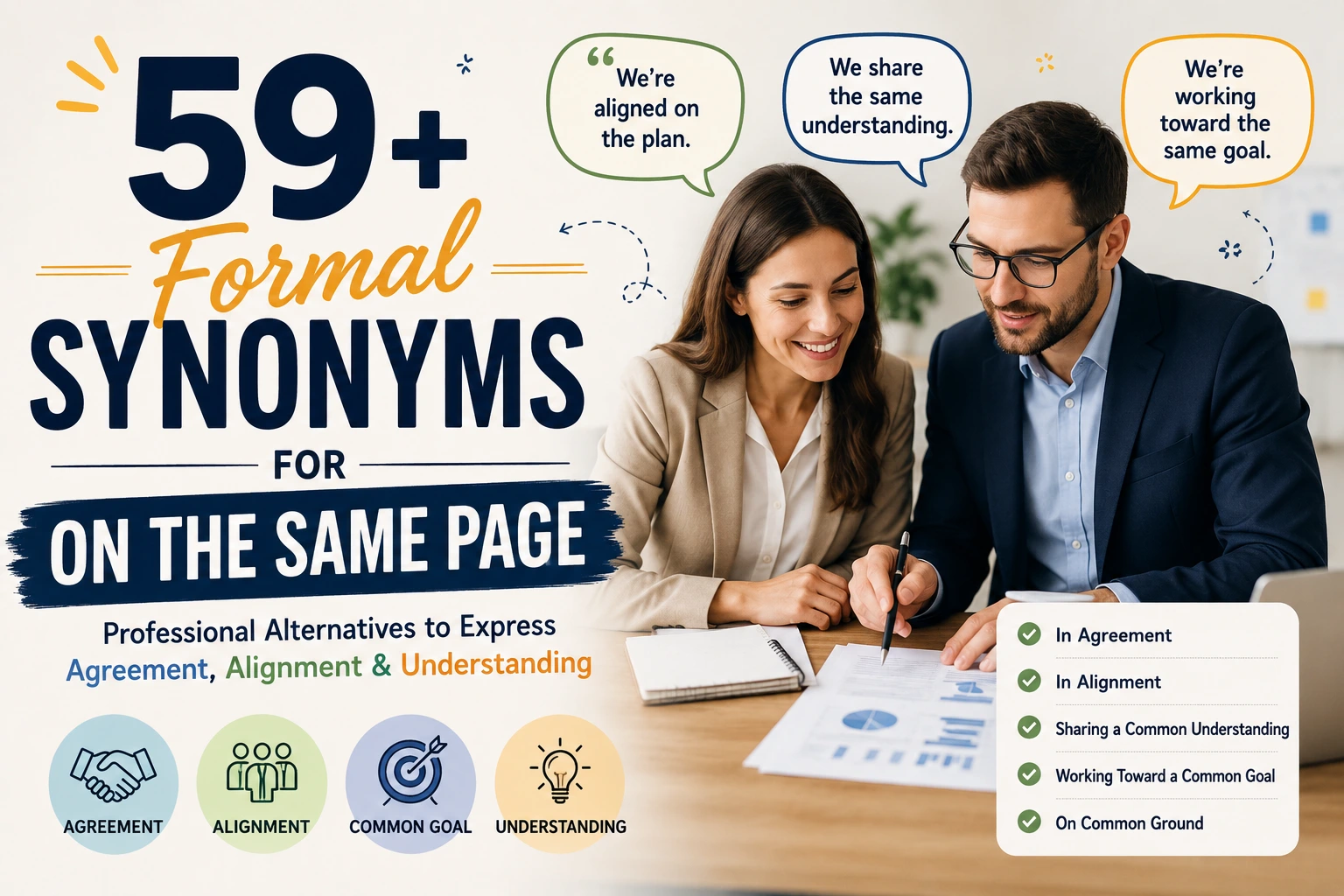
Clear communication is often the difference between a productive conversation and a confusing one. The phrase “on the same page” is widely used to describe people who share the same understanding, expectations, goals, or perspective. While it is perfectly natural in everyday workplace conversations, it can sometimes sound informal in business letters, reports, academic writing, and executive communication. Learning formal synonyms for “on the same page” gives you more precise ways to communicate agreement, alignment, understanding, and cooperation.
Using suitable alternatives can also make your writing sound more polished without making it unnecessarily complicated. Whether you are writing an email, preparing a presentation, communicating with a client, or discussing a project with colleagues, the right expression can strengthen your message. In this guide, you will discover more than 59 professional alternatives, including their meanings, tones, examples, and practical uses.
What Does Formal Synonyms for On the Same Page Mean?
“Formal synonyms for on the same page” refers to professional expressions that communicate a shared understanding, agreement, expectation, objective, or perspective.
The idiom “on the same page” is commonly used when two or more people understand a situation in a similar way.
For example:
“We need to make sure everyone is on the same page before we begin.”
The sentence means that everyone should have the same understanding of the plan.
In formal communication, alternatives such as “in agreement,” “in alignment,” “of the same understanding,” and “sharing a common objective” can communicate the same idea more precisely.
The emotional tone can range from neutral and professional to collaborative and positive, depending on the expression selected.
When to Use It
Formal alternatives to “on the same page” are useful in many communication settings.
Professional Emails
They are especially useful when discussing projects, expectations, decisions, or responsibilities.
Example:
“I would like to ensure that we are all aligned before proceeding.”
Business Meetings
Professional alternatives can help summarize agreement among team members.
Example:
“It appears that we are in agreement regarding the proposed strategy.”
Academic Writing
Formal language is often preferable in research papers, academic correspondence, and presentations.
Example:
“The findings indicate that the researchers share a common understanding of the issue.”
Workplace Communication
These expressions can clarify whether colleagues have the same expectations.
Example:
“Let us confirm that our expectations are aligned.”
Client Communication
When communicating with clients, polished expressions can sound more professional than casual idioms.
Example:
“We want to ensure that both parties have a shared understanding of the project requirements.”
Presentations and Speeches
Formal alternatives can make presentations sound more authoritative.
Example:
“Our teams are united around a common objective.”
Casual Professional Conversations
Some alternatives can still sound natural among colleagues.
Example:
“Let us make sure we are all aligned before moving forward.”
Is It Polite or Professional?
“On the same page” is polite and widely accepted, but it is generally considered conversational rather than highly formal. It is common in offices, meetings, emails, and everyday professional discussions.
For more formal situations, alternatives such as “in agreement,” “in alignment,” “mutually aligned,” and “sharing a common understanding” may be more appropriate.
The choice depends on your audience and purpose.
For a friendly workplace conversation, “Let us make sure we are on the same page” sounds completely natural.
For a formal business document, “Let us ensure that all stakeholders share a common understanding” sounds more polished.
For negotiations, “both parties are aligned on the proposed terms” may be especially effective.
Good professional writing is not about making every sentence complicated. It is about choosing language that accurately matches the situation.
1. In Agreement
Meaning: Having the same opinion or accepting the same position.
Tone: Formal, direct, professional.
“The committee members are in agreement regarding the proposed changes.”
Why to use it: This is one of the clearest formal alternatives to “on the same page.”
Purpose and Personalization: Use it when you want to emphasize agreement rather than simply shared understanding.
2. In Alignment
Meaning: Having compatible goals, expectations, or views.
Tone: Professional, strategic, formal.
“Our objectives are fully in alignment with the organization’s priorities.”
Why to use it: It is particularly effective in corporate and strategic communication.
Purpose and Personalization: Use it when discussing goals, plans, strategies, or priorities.
3. Fully Aligned
Meaning: Completely sharing the same understanding, direction, or objectives.
Tone: Professional, confident, corporate.
“The leadership team is fully aligned on the proposed strategy.”
Why to use it: It communicates a strong level of agreement.
Purpose and Personalization: Ideal for executive communication and project discussions.
4. Mutually Aligned
Meaning: Two or more parties have compatible goals or expectations.
Tone: Formal, collaborative, professional.
“Both departments are mutually aligned on the implementation schedule.”
Why to use it: It emphasizes agreement between different parties.
Purpose and Personalization: Useful for partnerships, negotiations, and cross departmental projects.
5. In Accord
Meaning: In agreement or harmony with another person or position.
Tone: Formal, sophisticated, professional.
“The recommendations are in accord with the organization’s long term objectives.”
Why to use it: It works well in formal documents and professional reports.
Purpose and Personalization: Choose it when you want an elegant alternative to simple agreement.
6. In Accordance
Meaning: Consistent with a rule, decision, standard, or principle.
Tone: Highly formal, official, precise.
“The revised procedure is in accordance with the agreed guidelines.”
Why to use it: This expression is better for consistency with standards than interpersonal agreement.
Purpose and Personalization: Use it when describing compliance or consistency with established expectations.
7. In Understanding
Meaning: Sharing a similar understanding of a situation.
Tone: Formal, neutral, professional.
“The two departments are in understanding regarding the project requirements.”
Why to use it: It directly emphasizes shared comprehension.
Purpose and Personalization: Useful when understanding is more important than agreement.
8. Of the Same Understanding
Meaning: Having the same interpretation or knowledge of a situation.
Tone: Formal, precise, professional.
“We should confirm that all stakeholders are of the same understanding before proceeding.”
Why to use it: This is a strong formal replacement for the original idiom.
Purpose and Personalization: Particularly suitable for agreements, procedures, and important decisions.
9. Sharing a Common Understanding
Meaning: Having a similar interpretation of an issue or situation.
Tone: Formal, academic, professional.
“The participants appear to share a common understanding of the objectives.”
Why to use it: It sounds polished and works well in reports and presentations.
Purpose and Personalization: Use it when clarity and comprehension are central to the discussion.
10. Sharing a Common Perspective
Meaning: Viewing an issue from a similar point of view.
Tone: Formal, thoughtful, professional.
“The two organizations are sharing a common perspective on sustainable development.”
Why to use it: This focuses on viewpoints rather than simple agreement.
Purpose and Personalization: Useful in discussions involving opinions, policies, and strategies.
11. Sharing the Same Perspective
Meaning: Having a similar way of viewing an issue.
Tone: Professional, neutral, conversational.
“The project leaders appear to be sharing the same perspective on resource allocation.”
Why to use it: It is useful when people have similar interpretations or opinions.
Purpose and Personalization: Choose it when the subject involves judgment or viewpoint.
12. United in Purpose
Meaning: Working together toward the same objective.
Tone: Formal, motivational, collaborative.
“The team remains united in purpose despite the challenges.”
Why to use it: It emphasizes collective commitment.
Purpose and Personalization: Excellent for leadership speeches, team communication, and organizational messages.
13. United Around a Common Goal
Meaning: Working together toward one shared objective.
Tone: Professional, motivational, collaborative.
“The departments are united around a common goal of improving customer satisfaction.”
Why to use it: This expression emphasizes teamwork and shared ambition.
Purpose and Personalization: Use it when discussing organizational goals or team performance.
14. Working Toward a Common Objective
Meaning: Cooperating to achieve the same result.
Tone: Formal, professional, collaborative.
“All stakeholders are working toward a common objective.”
Why to use it: It clearly communicates coordinated effort.
Purpose and Personalization: Ideal for project plans, reports, and team discussions.
15. Pursuing a Common Objective
Meaning: Seeking to achieve the same goal.
Tone: Formal, strategic, sophisticated.
“The two organizations are pursuing a common objective.”
Why to use it: It sounds polished in strategic and corporate communication.
Purpose and Personalization: Use it when describing long term goals or partnerships.
16. Working Toward Shared Goals
Meaning: Cooperating to achieve objectives that everyone has accepted.
Tone: Professional, collaborative, positive.
“The departments are working toward shared goals.”
Why to use it: It highlights cooperation and collective direction.
Purpose and Personalization: Useful in team updates and organizational planning.
17. United in Our Objectives
Meaning: Having the same goals or priorities.
Tone: Formal, confident, collaborative.
“We remain united in our objectives and committed to delivering quality results.”
Why to use it: It creates a strong sense of collective purpose.
Purpose and Personalization: Particularly effective in leadership communication.
18. Aligned in Our Objectives
Meaning: Having compatible or identical goals.
Tone: Formal, strategic, professional.
“Our teams are aligned in their objectives for the coming quarter.”
Why to use it: This is a strong choice for business and project communication.
Purpose and Personalization: Use it when discussing measurable organizational goals.
19. Aligned on Expectations
Meaning: Having the same understanding of what should happen.
Tone: Professional, practical, clear.
“Let us ensure that we are aligned on expectations before beginning the project.”
Why to use it: It is especially useful when responsibilities or outcomes need clarification.
Purpose and Personalization: Excellent for managers, clients, and project teams.
20. Aligned on Priorities
Meaning: Agreeing about which tasks or objectives matter most.
Tone: Professional, strategic.
“The leadership team is aligned on priorities for the upcoming quarter.”
Why to use it: It provides a precise alternative when discussing important tasks.
Purpose and Personalization: Best for planning and management conversations.
21. Aligned on the Approach
Meaning: Agreeing about how something should be handled.
Tone: Formal, professional, collaborative.
“We are aligned on the approach to resolving the issue.”
Why to use it: This is useful when people agree on a method rather than an outcome.
Purpose and Personalization: Use it during planning, problem solving, and strategy discussions.
22. In Consensus
Meaning: Sharing a general agreement reached by a group.
Tone: Formal, professional, academic.
“The panel is in consensus regarding the recommended course of action.”
Why to use it: It emphasizes collective agreement.
Purpose and Personalization: Particularly appropriate for committees, boards, and formal meetings.
23. In General Agreement
Meaning: Mostly or broadly agreeing about something.
Tone: Formal, measured, professional.
“The stakeholders are in general agreement regarding the proposed timeline.”
Why to use it: This expression allows for minor differences while showing overall agreement.
Purpose and Personalization: Useful when complete agreement has not necessarily been reached.
24. In Broad Agreement
Meaning: Agreeing on the main points while potentially differing on details.
Tone: Formal, diplomatic, professional.
“The parties are in broad agreement regarding the framework.”
Why to use it: It is excellent when the overall direction is shared but some details remain open.
Purpose and Personalization: Particularly useful in negotiations.
25. In Substantial Agreement
Meaning: Agreeing on most important matters.
Tone: Formal, precise, diplomatic.
“The negotiating teams are in substantial agreement on the principal terms.”
Why to use it: This sounds more precise than saying everyone agrees.
Purpose and Personalization: Use it when some minor points still require discussion.
26. In Full Agreement
Meaning: Completely agreeing with another person or group.
Tone: Formal, direct, professional.
“The board is in full agreement with the recommendation.”
Why to use it: It communicates complete agreement clearly.
Purpose and Personalization: Appropriate for official statements and formal decisions.
27. In Complete Agreement
Meaning: Sharing exactly the same position or opinion.
Tone: Formal, emphatic, professional.
“The members were in complete agreement regarding the proposed policy.”
Why to use it: Use this when agreement is especially strong.
Purpose and Personalization: It is effective when emphasizing unanimity.
28. In Mutual Agreement
Meaning: Agreement shared by all relevant parties.
Tone: Formal, diplomatic, professional.
“The terms were established through mutual agreement.”
Why to use it: It emphasizes that all parties accepted the same terms.
Purpose and Personalization: Commonly useful in contracts, negotiations, and business arrangements.
29. Mutually Agreed
Meaning: Accepted by all relevant parties.
Tone: Formal, contractual, professional.
“The parties proceeded according to the mutually agreed schedule.”
Why to use it: It is particularly useful for formal arrangements.
Purpose and Personalization: Best when referring to decisions, timelines, terms, or conditions.
30. Common Ground Has Been Established
Meaning: The parties have found areas of agreement.
Tone: Formal, diplomatic, constructive.
“Common ground has been established regarding the primary objectives.”
Why to use it: This expression is excellent for negotiations and conflict resolution.
Purpose and Personalization: Use it when people have moved from disagreement toward cooperation.
31. We Have Reached Common Ground
Meaning: Everyone has found an area of shared agreement.
Tone: Professional, diplomatic, collaborative.
“We have reached common ground on the proposed implementation strategy.”
Why to use it: It communicates progress toward agreement.
Purpose and Personalization: Particularly effective in meetings and negotiations.
32. We Share the Same Objectives
Meaning: Everyone is working toward identical goals.
Tone: Professional, collaborative, clear.
“We share the same objectives for improving operational efficiency.”
Why to use it: It directly communicates shared goals.
Purpose and Personalization: Use it to emphasize cooperation between individuals or organizations.
33. We Share Common Goals
Meaning: Everyone has important goals in common.
Tone: Professional, positive, collaborative.
“We share common goals and are committed to achieving measurable results.”
Why to use it: It sounds natural while remaining professional.
Purpose and Personalization: Suitable for partnerships and team communication.
34. We Share a Common Vision
Meaning: Everyone has a similar long term idea of what they want to achieve.
Tone: Inspirational, professional, strategic.
“We share a common vision for the future of the organization.”
Why to use it: This is especially effective for leadership and strategic communication.
Purpose and Personalization: Use it when discussing long term direction rather than immediate tasks.
35. We Are Collectively Aligned
Meaning: The group has reached a shared position or direction.
Tone: Formal, corporate, strategic.
“We are collectively aligned on the next phase of development.”
Why to use it: It emphasizes group level agreement.
Purpose and Personalization: Useful for executive reports and team meetings.
36. We Are Collectively in Agreement
Meaning: Everyone in the group agrees.
Tone: Formal, precise, professional.
“We are collectively in agreement regarding the proposed recommendation.”
Why to use it: This is a clear formal alternative to the idiom.
Purpose and Personalization: Appropriate for committees and group decisions.
37. We Have a Shared Understanding
Meaning: Everyone understands the situation in a similar way.
Tone: Formal, professional, collaborative.
“We now have a shared understanding of the project’s requirements.”
Why to use it: It focuses on comprehension rather than agreement.
Purpose and Personalization: Ideal when clarifying instructions or expectations.
38. We Have a Common Understanding
Meaning: Everyone has reached a similar interpretation.
Tone: Formal, academic, professional.
“We have a common understanding of the responsibilities involved.”
Why to use it: It sounds polished in formal documents and meetings.
Purpose and Personalization: Use it when clarity is the main objective.
39. We Have Established Shared Expectations
Meaning: Everyone understands what should happen and what is expected.
Tone: Formal, practical, professional.
“We have established shared expectations for the next stage of the project.”
Why to use it: This is especially useful for workplace planning.
Purpose and Personalization: Use it when roles, deadlines, and outcomes need clarification.
40. Our Expectations Are Aligned
Meaning: Everyone expects similar outcomes or responsibilities.
Tone: Professional, clear, strategic.
“It is important to ensure that our expectations are aligned from the beginning.”
Why to use it: This is a natural and highly useful business expression.
Purpose and Personalization: Excellent for client relationships and project management.
41. Our Perspectives Are Aligned
Meaning: People view an issue in a similar way.
Tone: Formal, thoughtful, professional.
“Our perspectives are aligned regarding the proposed changes.”
Why to use it: This expression focuses on viewpoints rather than goals.
Purpose and Personalization: Use it when discussing opinions, interpretations, or strategy.
42. Our Views Are Consistent
Meaning: Our opinions or interpretations do not significantly differ.
Tone: Formal, neutral, analytical.
“Our views are consistent regarding the importance of early intervention.”
Why to use it: It works well in reports and professional discussions.
Purpose and Personalization: Choose it when you want to emphasize consistency.
43. Our Positions Are Aligned
Meaning: Our official opinions or approaches are compatible.
Tone: Formal, diplomatic, professional.
“Our positions are aligned on the proposed framework.”
Why to use it: This is particularly suitable for negotiations and organizational communication.
Purpose and Personalization: Use it when representing formal viewpoints.
44. Our Interests Are Aligned
Meaning: Everyone can benefit from pursuing the same outcome.
Tone: Strategic, professional, diplomatic.
“Our interests are aligned in developing a sustainable solution.”
Why to use it: It emphasizes mutual benefit.
Purpose and Personalization: Particularly useful in partnerships, negotiations, and business development.
45. Our Priorities Are Aligned
Meaning: Everyone considers the same matters important.
Tone: Professional, strategic, concise.
“Our priorities are aligned, which should allow the project to progress efficiently.”
Why to use it: It communicates agreement about what deserves attention.
Purpose and Personalization: Excellent for managers and project leaders.
46. Our Goals Are Consistent
Meaning: Everyone’s goals support the same direction.
Tone: Formal, neutral, professional.
“Our goals are consistent with the broader organizational strategy.”
Why to use it: It works well in strategic documents.
Purpose and Personalization: Use it when discussing organizational planning.
47. Our Objectives Are Shared
Meaning: Everyone has the same objectives.
Tone: Formal, concise, professional.
“Our objectives are shared across both departments.”
Why to use it: It provides a concise alternative to the common idiom.
Purpose and Personalization: Useful in reports and business presentations.
48. We Are Working in Concert
Meaning: People are cooperating closely toward a common purpose.
Tone: Formal, sophisticated, collaborative.
“The departments are working in concert to improve service delivery.”
Why to use it: It emphasizes coordinated action.
Purpose and Personalization: Use it when describing close cooperation between groups.
49. We Are Acting in Concert
Meaning: Multiple people or organizations are taking coordinated action.
Tone: Formal, strategic, sophisticated.
“The organizations are acting in concert to address the issue.”
Why to use it: This sounds polished in formal reports and public communication.
Purpose and Personalization: Best when describing coordinated action rather than simple agreement.
50. We Are Operating in Alignment
Meaning: People or departments are functioning according to the same direction or principles.
Tone: Formal, corporate, strategic.
“Both teams are operating in alignment with the approved strategy.”
Why to use it: This expression is useful for organizational processes.
Purpose and Personalization: Use it when discussing execution, policies, or procedures.
51. We Are Moving in the Same Direction
Meaning: Everyone is progressing toward the same outcome.
Tone: Professional, motivational, accessible.
“The organization is moving in the same direction regarding its growth strategy.”
Why to use it: It communicates unity in a simple but professional way.
Purpose and Personalization: Useful when speaking to teams about progress and strategy.
52. We Are Pursuing the Same Direction
Meaning: Everyone is following a similar strategic path.
Tone: Formal, strategic, professional.
“The departments are pursuing the same strategic direction.”
Why to use it: It is useful for organizational planning.
Purpose and Personalization: Best suited to strategy and long term planning.
53. We Are Coordinated
Meaning: People are organized and working together effectively.
Tone: Professional, practical, direct.
“The project teams are fully coordinated before the launch.”
Why to use it: It focuses on organized cooperation.
Purpose and Personalization: Use it when shared understanding has led to coordinated action.
54. We Are Working in Harmony
Meaning: People are cooperating smoothly and without significant disagreement.
Tone: Warm, professional, positive.
“The departments are working in harmony toward a shared objective.”
Why to use it: It adds a positive and cooperative emotional tone.
Purpose and Personalization: Suitable for team building and organizational communication.
55. We Are in Step
Meaning: People are progressing or acting together in a coordinated way.
Tone: Professional, concise, moderately formal.
“The project teams remain in step with the agreed implementation schedule.”
Why to use it: It is a concise expression of coordination.
Purpose and Personalization: Use it when timing and coordinated progress matter.
56. We Are Synchronized
Meaning: People or processes are operating together in a coordinated manner.
Tone: Modern, professional, strategic.
“The teams are fully synchronized on the project timeline.”
Why to use it: It works particularly well in operational and technology related contexts.
Purpose and Personalization: Use it when coordination and timing are important.
57. We Are on Common Ground
Meaning: We share an area of agreement.
Tone: Professional, diplomatic, approachable.
“The negotiating teams are now on common ground regarding the principal objectives.”
Why to use it: It is more formal than some conversational idioms while remaining natural.
Purpose and Personalization: Excellent for negotiations and conflict resolution.
58. We Have Reached a Shared Position
Meaning: Everyone has arrived at a similar or agreed viewpoint.
Tone: Formal, diplomatic, professional.
“The committee has reached a shared position on the proposed policy.”
Why to use it: It emphasizes the outcome of a discussion.
Purpose and Personalization: Particularly useful in reports and formal meeting summaries.
59. We Have Reached a Common Position
Meaning: Different parties have agreed on the same stance.
Tone: Formal, diplomatic, authoritative.
“The participating organizations have reached a common position on the issue.”
Why to use it: It is excellent for formal negotiations and institutional communication.
Purpose and Personalization: Use it when representing multiple groups or stakeholders.
60. We Are in Full Accord
Meaning: Everyone completely agrees.
Tone: Highly formal, sophisticated, authoritative.
“The members of the committee are in full accord regarding the proposed recommendation.”
Why to use it: This is an elegant alternative for highly formal writing.
Purpose and Personalization: Best reserved for official statements, reports, and formal correspondence.
61. We Are in Agreement Regarding the Matter
Meaning: Everyone agrees about the particular issue being discussed.
Tone: Formal, precise, professional.
“The relevant stakeholders are in agreement regarding the matter under consideration.”
Why to use it: It is direct and suitable for formal documentation.
Purpose and Personalization: Use it when precision is more important than conversational warmth.
62. We Share a Unified Understanding
Meaning: Everyone has reached the same interpretation of a situation.
Tone: Formal, sophisticated, collaborative.
“The leadership team shares a unified understanding of the challenges ahead.”
Why to use it: It emphasizes both unity and comprehension.
Purpose and Personalization: Particularly effective in strategic communication and leadership writing.
How to Choose the Best Alternative
Choosing the right formal synonym depends on what you actually want to communicate.
If you mean simple agreement, use “in agreement” or “in full accord.”
If you mean shared goals, choose “our objectives are aligned” or “we share common goals.”
If you mean shared understanding, use “we have a shared understanding” or “of the same understanding.”
If you mean strategic cooperation, “in alignment” or “operating in alignment” can work well.
If you mean compromise, “we have reached common ground” is a strong option.
If you mean coordinated action, “working in concert” or “fully coordinated” may be more precise.
Avoid choosing a phrase simply because it sounds sophisticated. The best expression is the one that accurately describes the relationship between the people, ideas, or organizations involved.
Common Mistakes to Avoid
Using Overly Casual Language in Formal Documents
“On the same page” is perfectly acceptable in many workplace conversations, but a formal report may benefit from “in agreement” or “sharing a common understanding.”
Confusing Agreement With Understanding
Two people can understand the same situation without agreeing about it. If comprehension is the focus, use “shared understanding” rather than “in agreement.”
Using Corporate Language Unnecessarily
Expressions such as “aligned,” “synchronized,” and “operating in alignment” are useful, but excessive corporate terminology can make writing feel artificial.
Assuming Complete Agreement
If people agree on most issues but still have differences, “in broad agreement” is more accurate than “in complete agreement.”
Ignoring the Context
A phrase suitable for a board meeting may sound unnatural in a casual conversation. Always consider the audience and communication setting.
Conclusion
Formal alternatives to “on the same page” allow you to express agreement, shared understanding, cooperation, and common goals with greater precision. Expressions such as “in alignment,” “sharing a common understanding,” “our objectives are aligned,” and “we have reached common ground” can make professional communication clearer and more polished. The best alternative depends on whether you want to emphasize agreement, comprehension, teamwork, or strategic direction.
Discover more
good synonyms for if time permits