
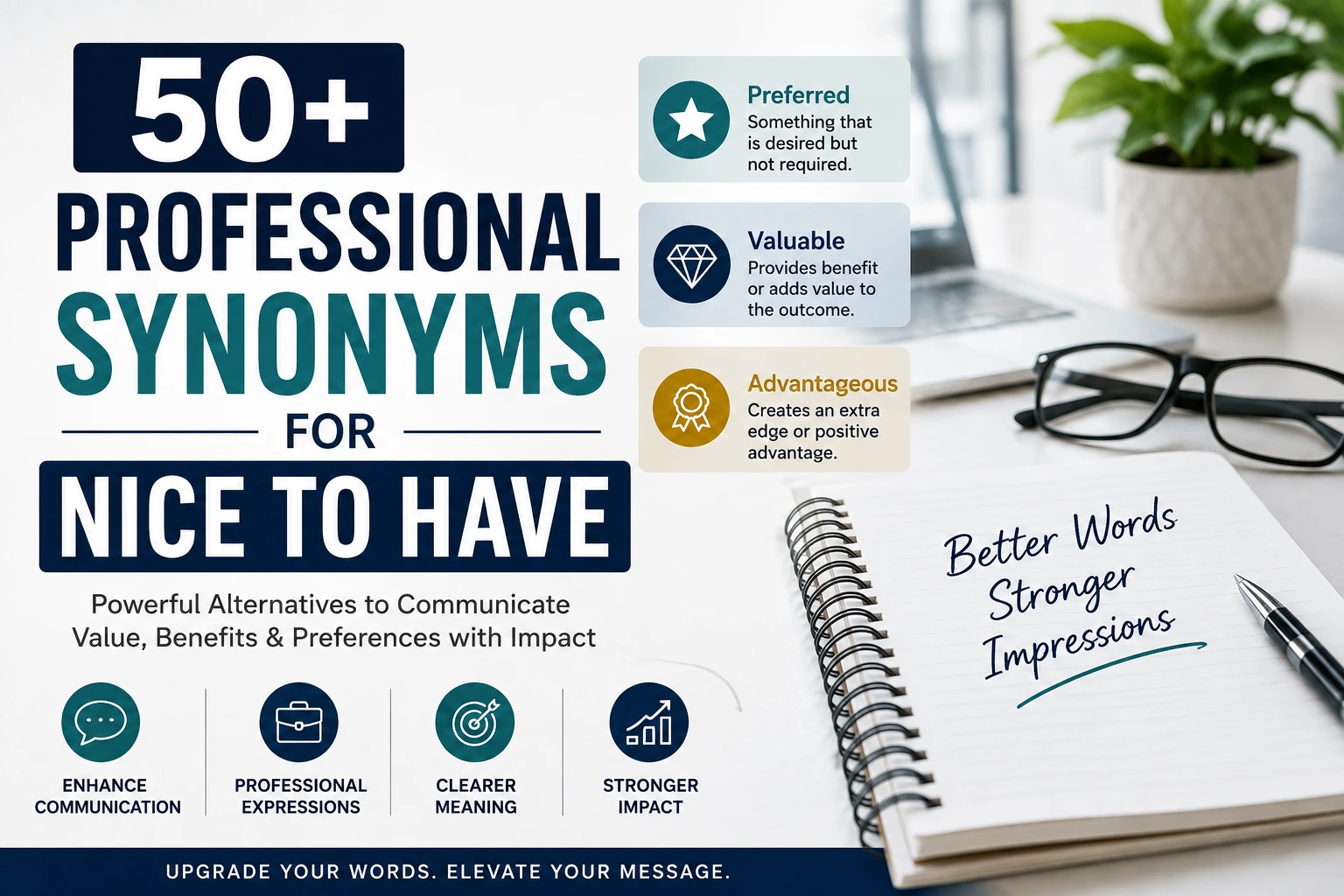
The right words can turn a simple workplace comment into polished and purposeful communication. The phrase “nice to have” is commonly used to describe something useful, desirable, or beneficial, but not necessarily essential. While it is perfectly natural in everyday conversation, professional writing often benefits from more precise alternatives. Using professional synonyms for nice to have can help you communicate value, priority, usefulness, and preference with greater clarity. This is especially important in business emails, reports, resumes, proposals, meetings, presentations, and workplace discussions. Instead of repeatedly saying that something would be “nice to have,” you can choose an expression that better reflects your intended meaning. Whether you want to sound formal, diplomatic, persuasive, strategic, or friendly, the alternatives in this guide can help you make your communication more polished and effective.
What Does Professional Synonyms for Nice to Have Mean?
The phrase “nice to have” describes something that would be beneficial, useful, desirable, or appreciated but is not strictly necessary.
For example:
“Additional reporting features would be nice to have.”
This means that the features would improve the product or experience, but the product could still function without them.
In professional communication, the phrase can describe optional benefits, preferred features, additional resources, desirable qualifications, or improvements. However, it can sometimes sound informal or vague. More precise alternatives allow you to communicate whether something is beneficial, preferred, valuable, advantageous, desirable, or worth considering.
When to Use It
The phrase “nice to have” is common in workplace conversations, but more polished alternatives can be useful depending on the situation.
Professional Emails
Use a formal alternative when discussing optional improvements or resources.
“An additional review would be beneficial before publication.”
Business Meetings
When discussing priorities, you can distinguish between essential requirements and desirable additions.
“The reporting feature would be a valuable addition to the platform.”
Job Descriptions
Professional alternatives can describe preferred qualifications without making them mandatory.
“Experience with data analysis would be advantageous.”
Resumes and Cover Letters
A candidate can describe desirable skills using precise professional language.
“Advanced presentation skills would be an added advantage in this position.”
Proposals
Formal alternatives can make recommendations sound more strategic.
“Additional market research would provide further value to the proposal.”
Casual Workplace Conversations
For familiar colleagues, expressions such as “a useful addition” or “something worth considering” sound natural while remaining professional.
Is It Polite or Professional?
“Nice to have” is polite and widely understood, but it is somewhat informal. It works well in everyday workplace conversations, brainstorming sessions, product discussions, and internal meetings. However, it may sound less precise in formal reports, business proposals, academic writing, or executive communication.
Professional alternatives provide greater clarity because they can communicate different levels of importance. For example, “beneficial” suggests usefulness, “advantageous” emphasizes a positive outcome, and “desirable” indicates preference. “An added advantage” highlights an extra benefit, while “a valuable addition” suggests that something would meaningfully improve the situation.
The best alternative depends on what you want to communicate and how strongly you want to emphasize its value.
1. Beneficial
Meaning: Something that provides a positive effect or advantage.
Tone: Professional, neutral
“Additional training would be beneficial for the new team members.”
Short Explanation: Use this when an optional feature, action, or resource would produce a useful outcome.
Purpose and Personalization: This is one of the most versatile professional alternatives to “nice to have.”
2. Advantageous
Meaning: Something that creates a useful benefit or favorable position.
Tone: Formal, strategic
“Previous industry experience would be advantageous for this position.”
Short Explanation: Use this when emphasizing how something could improve results or create an advantage.
Purpose and Personalization: It works particularly well in job descriptions and professional recommendations.
3. Desirable
Meaning: Something that is wanted or preferred.
Tone: Formal, professional
“Experience with international clients would be desirable.”
Short Explanation: Use this when something is preferred but not absolutely required.
Purpose and Personalization: It is especially useful when distinguishing preferred qualities from mandatory requirements.
4. Valuable
Meaning: Something that provides meaningful benefit or usefulness.
Tone: Professional, positive
“Your additional perspective would be valuable to the project.”
Short Explanation: Use this when you want to emphasize the importance or usefulness of an optional contribution.
Purpose and Personalization: It adds warmth while maintaining a professional tone.
5. Useful
Meaning: Something that can provide practical assistance or benefit.
Tone: Neutral, professional
“A centralized dashboard would be useful for monitoring performance.”
Short Explanation: Use this when the primary value of something is practical usefulness.
Purpose and Personalization: It is simple, natural, and appropriate for everyday workplace communication.
6. Beneficial Addition
Meaning: Something that would improve an existing situation.
Tone: Professional, positive
“The additional reporting function would be a beneficial addition to the system.”
Short Explanation: Use this when describing an optional improvement to an existing product, service, or process.
Purpose and Personalization: It clearly communicates value without implying necessity.
7. Valuable Addition
Meaning: Something that would meaningfully improve an existing arrangement.
Tone: Professional, appreciative
“Your expertise would be a valuable addition to the team.”
Short Explanation: Use this when emphasizing the contribution something or someone could make.
Purpose and Personalization: This phrase works especially well in recruitment and team communication.
8. Useful Addition
Meaning: Something that would provide additional practical value.
Tone: Professional, straightforward
“An automated reminder system would be a useful addition.”
Short Explanation: Use it for optional features, tools, resources, or processes.
Purpose and Personalization: It is direct without sounding overly formal.
9. Added Advantage
Meaning: An additional benefit beyond the basic requirements.
Tone: Professional, positive
“Fluency in another language would be an added advantage.”
Short Explanation: Use this when something gives a person, project, or organization an extra benefit.
Purpose and Personalization: It is especially common in professional and recruitment contexts.
10. Additional Benefit
Meaning: An extra positive outcome or feature.
Tone: Professional, neutral
“Flexible scheduling would provide an additional benefit to employees.”
Short Explanation: Use this when discussing an optional improvement or advantage.
Purpose and Personalization: It clearly communicates that the feature is supplementary rather than essential.
11. Worthwhile
Meaning: Something that provides enough benefit to justify consideration or effort.
Tone: Professional, positive
“Investing in additional training could be worthwhile.”
Short Explanation: Use this when an optional action appears valuable enough to pursue.
Purpose and Personalization: It is useful when making recommendations without sounding forceful.
12. Deserving of Consideration
Meaning: Something that should reasonably be evaluated or considered.
Tone: Formal, diplomatic
“The proposed alternative is deserving of consideration.”
Short Explanation: Use this when you want to recommend an option without insisting on it.
Purpose and Personalization: It is particularly suitable for formal reports and business proposals.
13. Worth Considering
Meaning: Something that may provide enough value to deserve attention.
Tone: Professional, conversational
“An extended warranty is worth considering for long term use.”
Short Explanation: Use this when presenting an optional recommendation.
Purpose and Personalization: It sounds natural while remaining appropriately professional.
14. Worthwhile Addition
Meaning: Something that would make a useful improvement.
Tone: Professional, positive
“A customer feedback section would be a worthwhile addition to the report.”
Short Explanation: Use this when recommending an optional enhancement.
Purpose and Personalization: It communicates value without suggesting that the addition is mandatory.
15. Favorable
Meaning: Likely to produce a positive result or improve circumstances.
Tone: Formal, professional
“Additional market data would be favorable to the decision making process.”
Short Explanation: Use this when an optional resource could support a positive outcome.
Purpose and Personalization: It works well in analytical and business writing.
16. Preferable
Meaning: More desirable or suitable than another option.
Tone: Formal, analytical
“A direct consultation would be preferable before making a final decision.”
Short Explanation: Use this when comparing options and identifying a preferred choice.
Purpose and Personalization: It is useful when you want to communicate preference rather than necessity.
17. Recommended
Meaning: Something advised as a good option.
Tone: Professional, authoritative
“Additional quality checks are recommended before publication.”
Short Explanation: Use this when an optional action is strongly encouraged.
Purpose and Personalization: It is stronger than “nice to have” and works well in professional guidance.
18. Advisable
Meaning: Sensible or beneficial to do.
Tone: Formal, professional
“A second review would be advisable before submission.”
Short Explanation: Use this when an action is not strictly required but would be sensible.
Purpose and Personalization: It is useful in professional recommendations and formal correspondence.
19. Desirable Feature
Meaning: A feature that would be preferred or appreciated.
Tone: Professional, technical
“Offline access would be a desirable feature for frequent travelers.”
Short Explanation: Use this when discussing products, services, software, or systems.
Purpose and Personalization: It communicates preference without implying that the feature is essential.
20. Preferred
Meaning: More desirable than available alternatives.
Tone: Professional, direct
“Previous management experience is preferred for this position.”
Short Explanation: Use this when identifying something that would strengthen an application or outcome.
Purpose and Personalization: It is particularly effective in job descriptions and selection criteria.
21. Favorable Addition
Meaning: An extra feature or resource that could improve the situation.
Tone: Formal, positive
“Additional documentation would be a favorable addition to the proposal.”
Short Explanation: Use this in formal recommendations and professional evaluations.
Purpose and Personalization: It communicates potential value in a measured way.
22. Positive Addition
Meaning: Something that would improve an existing situation.
Tone: Professional, friendly
“Your experience would be a positive addition to the project team.”
Short Explanation: Use this when describing an extra contribution that could benefit a group.
Purpose and Personalization: It works well when acknowledging someone’s potential contribution.
23. Meaningful Addition
Meaning: Something that provides substantial or noticeable value.
Tone: Professional, thoughtful
“Additional customer research would be a meaningful addition to the proposal.”
Short Explanation: Use this when the optional feature would have a noticeable impact.
Purpose and Personalization: It sounds more substantial than simply saying “useful.”
24. Significant Benefit
Meaning: An advantage that could have an important positive effect.
Tone: Formal, strategic
“The new training program could provide a significant benefit to employees.”
Short Explanation: Use this when the potential value is considerable.
Purpose and Personalization: It is useful in business cases, proposals, and strategic communication.
25. Additional Value
Meaning: Extra usefulness or benefit beyond what already exists.
Tone: Professional, corporate
“The new feature could provide additional value to customers.”
Short Explanation: Use this when describing enhancements that improve an existing product or service.
Purpose and Personalization: It is particularly effective in business and marketing communication.
26. Added Value
Meaning: An extra benefit that improves overall usefulness or quality.
Tone: Professional, business focused
“The consultation would provide added value to the project.”
Short Explanation: Use this when emphasizing an extra benefit rather than a basic requirement.
Purpose and Personalization: This phrase is widely suitable for business proposals and client communication.
27. Complementary
Meaning: Something that enhances or works well with something else.
Tone: Formal, professional
“Additional research would be complementary to the existing analysis.”
Short Explanation: Use this when an optional element strengthens an existing resource.
Purpose and Personalization: It is useful when describing supporting materials, skills, or services.
28. Enhancing
Meaning: Something that improves quality, effectiveness, or value.
Tone: Professional, positive
“Additional visuals would be enhancing for the final presentation.”
Short Explanation: Use this when describing an optional element that improves an existing result.
Purpose and Personalization: It is suitable for presentations, reports, marketing materials, and projects.
29. An Enhancement
Meaning: An improvement or upgrade to something that already exists.
Tone: Professional, technical
“The new reporting function would be a useful enhancement.”
Short Explanation: Use this when describing an optional improvement to a system or process.
Purpose and Personalization: It is particularly appropriate in product development and technology discussions.
30. An Improvement
Meaning: A change that makes something better.
Tone: Neutral, professional
“Automated notifications would represent a practical improvement.”
Short Explanation: Use this when the proposed addition directly improves performance or convenience.
Purpose and Personalization: It is clear and broadly applicable across professional settings.
31. A Welcome Addition
Meaning: Something that would be appreciated and beneficial.
Tone: Warm, professional
“Additional seating would be a welcome addition to the conference area.”
Short Explanation: Use this when you want to combine professionalism with a sense of appreciation.
Purpose and Personalization: It is especially useful when giving constructive suggestions.
32. A Useful Resource
Meaning: Something that can provide practical assistance.
Tone: Professional, practical
“The online database would be a useful resource for the research team.”
Short Explanation: Use this when referring to optional information, tools, or materials.
Purpose and Personalization: It works well in academic, corporate, and project environments.
33. A Valuable Resource
Meaning: A resource that could provide substantial benefit.
Tone: Professional, appreciative
“The additional market report would be a valuable resource for the team.”
Short Explanation: Use this when the optional resource has meaningful practical value.
Purpose and Personalization: It adds a stronger sense of importance than “useful resource.”
34. A Helpful Addition
Meaning: Something that would make a task or process easier.
Tone: Friendly, professional
“A checklist would be a helpful addition to the training materials.”
Short Explanation: Use this when emphasizing convenience or practical support.
Purpose and Personalization: It provides a warm alternative suitable for workplace communication.
35. A Practical Addition
Meaning: Something that provides realistic or functional value.
Tone: Professional, practical
“A searchable archive would be a practical addition to the website.”
Short Explanation: Use this when the proposed addition solves a practical need.
Purpose and Personalization: It is useful in technical, operational, and business discussions.
36. A Strategic Advantage
Meaning: Something that could provide a meaningful competitive or organizational benefit.
Tone: Strategic, formal
“Early market research could provide a strategic advantage.”
Short Explanation: Use this when an optional resource could strengthen a broader strategy.
Purpose and Personalization: It works especially well in executive communication and business planning.
37. A Competitive Advantage
Meaning: Something that helps an organization perform better than competitors.
Tone: Formal, strategic
“Faster customer support could provide a competitive advantage.”
Short Explanation: Use this when describing an optional feature that could strengthen market position.
Purpose and Personalization: It is ideal for business strategy and marketing contexts.
38. An Added Benefit
Meaning: An extra positive result or advantage.
Tone: Professional, neutral
“Flexible working arrangements would be an added benefit for employees.”
Short Explanation: Use this when highlighting an extra advantage beyond the primary purpose.
Purpose and Personalization: It sounds natural in workplace and organizational communication.
39. An Additional Advantage
Meaning: An extra factor that provides benefit.
Tone: Formal, professional
“International experience would be an additional advantage for this role.”
Short Explanation: Use this when discussing desirable qualifications or capabilities.
Purpose and Personalization: It is particularly useful for recruitment and professional evaluations.
40. An Attractive Option
Meaning: A choice that appears desirable or beneficial.
Tone: Professional, persuasive
“Flexible payment terms could be an attractive option for smaller clients.”
Short Explanation: Use this when presenting an alternative that may appeal to the audience.
Purpose and Personalization: It is useful in proposals, sales communication, and business discussions.
41. A Desirable Option
Meaning: A choice that would be preferred or beneficial.
Tone: Formal, professional
“Remote participation would be a desirable option for international attendees.”
Short Explanation: Use this when discussing optional choices.
Purpose and Personalization: It communicates preference clearly without suggesting necessity.
42. A Preferred Option
Meaning: A choice favored over alternatives.
Tone: Professional, direct
“A phased implementation would be the preferred option.”
Short Explanation: Use this when expressing a clear preference among several possibilities.
Purpose and Personalization: It works well in recommendations and decision making.
43. A Strong Addition
Meaning: Something that would significantly improve an existing situation.
Tone: Professional, positive
“Your technical expertise would be a strong addition to the team.”
Short Explanation: Use this when recognizing the potential contribution of a person, skill, or resource.
Purpose and Personalization: It adds confidence and appreciation to professional communication.
44. A Useful Enhancement
Meaning: An improvement that provides practical benefit.
Tone: Professional, technical
“A filtering system would be a useful enhancement to the application.”
Short Explanation: Use this when discussing optional product or process improvements.
Purpose and Personalization: It is particularly appropriate for technology and operations.
45. A Valuable Enhancement
Meaning: An improvement that adds meaningful value.
Tone: Formal, positive
“Real time reporting would be a valuable enhancement to the platform.”
Short Explanation: Use this when an improvement could meaningfully strengthen an existing system.
Purpose and Personalization: It is polished and effective in business proposals.
46. A Worthwhile Enhancement
Meaning: An improvement that would justify the investment or effort.
Tone: Professional, analytical
“Improved accessibility would be a worthwhile enhancement to the website.”
Short Explanation: Use this when recommending an optional improvement that deserves serious consideration.
Purpose and Personalization: It communicates value while remaining measured.
47. An Appreciated Addition
Meaning: Something that would likely be welcomed or valued.
Tone: Warm, professional
“Additional flexibility would be an appreciated addition to the policy.”
Short Explanation: Use this when you want to emphasize how positively an addition may be received.
Purpose and Personalization: It is useful when communicating suggestions with warmth.
48. A Welcome Benefit
Meaning: An additional advantage that would be positively received.
Tone: Friendly, professional
“Flexible scheduling would be a welcome benefit for employees.”
Short Explanation: Use this when discussing optional benefits that could improve people’s experience.
Purpose and Personalization: It works well in workplace policies and employee communication.
49. A Desirable Benefit
Meaning: A benefit that people would value or prefer.
Tone: Formal, professional
“Professional development opportunities would be a desirable benefit for applicants.”
Short Explanation: Use this when describing optional benefits in employment or service contexts.
Purpose and Personalization: It is especially useful for recruitment and organizational communication.
50. A Valuable Opportunity
Meaning: An opportunity that could provide meaningful benefit or growth.
Tone: Professional, motivational
“The training program would provide a valuable opportunity for professional development.”
Short Explanation: Use this when describing an optional experience that could lead to growth or improvement.
Purpose and Personalization: It adds a positive and forward looking quality to professional writing.
51. An Advantageous Opportunity
Meaning: An opportunity that could create useful benefits.
Tone: Formal, strategic
“The partnership represents an advantageous opportunity for both organizations.”
Short Explanation: Use this when an optional opportunity could produce significant professional or strategic value.
Purpose and Personalization: It is appropriate for proposals, partnerships, and business development.
52. A Positive Opportunity
Meaning: An opportunity likely to produce a favorable outcome.
Tone: Professional, optimistic
“The new training initiative presents a positive opportunity for staff development.”
Short Explanation: Use this when you want to highlight potential benefits without overstating certainty.
Purpose and Personalization: It provides an optimistic yet measured alternative to “nice to have.”
53. A Useful Consideration
Meaning: Something that deserves attention because it may provide value.
Tone: Formal, analytical
“Accessibility should be a useful consideration during the design process.”
Short Explanation: Use this when presenting an optional factor for decision making.
Purpose and Personalization: It works well in reports, planning documents, and strategic discussions.
54. A Relevant Addition
Meaning: Something that is connected to the subject and may provide useful value.
Tone: Formal, professional
“Additional customer feedback would be a relevant addition to the analysis.”
Short Explanation: Use this when an optional element directly supports the subject being discussed.
Purpose and Personalization: It communicates relevance without suggesting that the addition is essential.
55. A Meaningful Benefit
Meaning: A benefit that provides noticeable or important value.
Tone: Professional, thoughtful
“Flexible working arrangements can provide a meaningful benefit to employees.”
Short Explanation: Use this when you want to emphasize a benefit that genuinely matters.
Purpose and Personalization: It works well in workplace policies, proposals, and organizational communication.
How to Choose the Right Professional Alternative
The best synonym for “nice to have” depends on what you want to communicate. If something is useful, “beneficial” or “valuable” may be appropriate. If it is preferred but not required, “desirable” or “preferred” is more precise. If it creates a competitive benefit, “strategic advantage” or “competitive advantage” may be stronger.
For professional emails, “a useful addition,” “a valuable addition,” and “worth considering” are natural choices. For job descriptions, “desirable,” “advantageous,” and “preferred” work particularly well. In business proposals, “additional value,” “meaningful benefit,” and “strategic advantage” can communicate greater impact.
Rather than replacing “nice to have” simply for variety, consider the exact level of importance and benefit you want to express. Precision makes professional communication more convincing.
Conclusion
Using professional synonyms for nice to have can make your communication more precise, polished, and purposeful. Instead of relying on one informal expression, you can choose words such as “beneficial,” “advantageous,” “desirable,” “valuable,” “worthwhile,” or “a valuable addition” based on your specific context. These alternatives help distinguish between something that is merely appreciated, something that provides meaningful value, and something that creates a strategic advantage. Whether you are writing an email, proposal, report, job description, presentation, or workplace message, choosing the right expression can strengthen your message.
Discover more
good synonyms for if time permits