
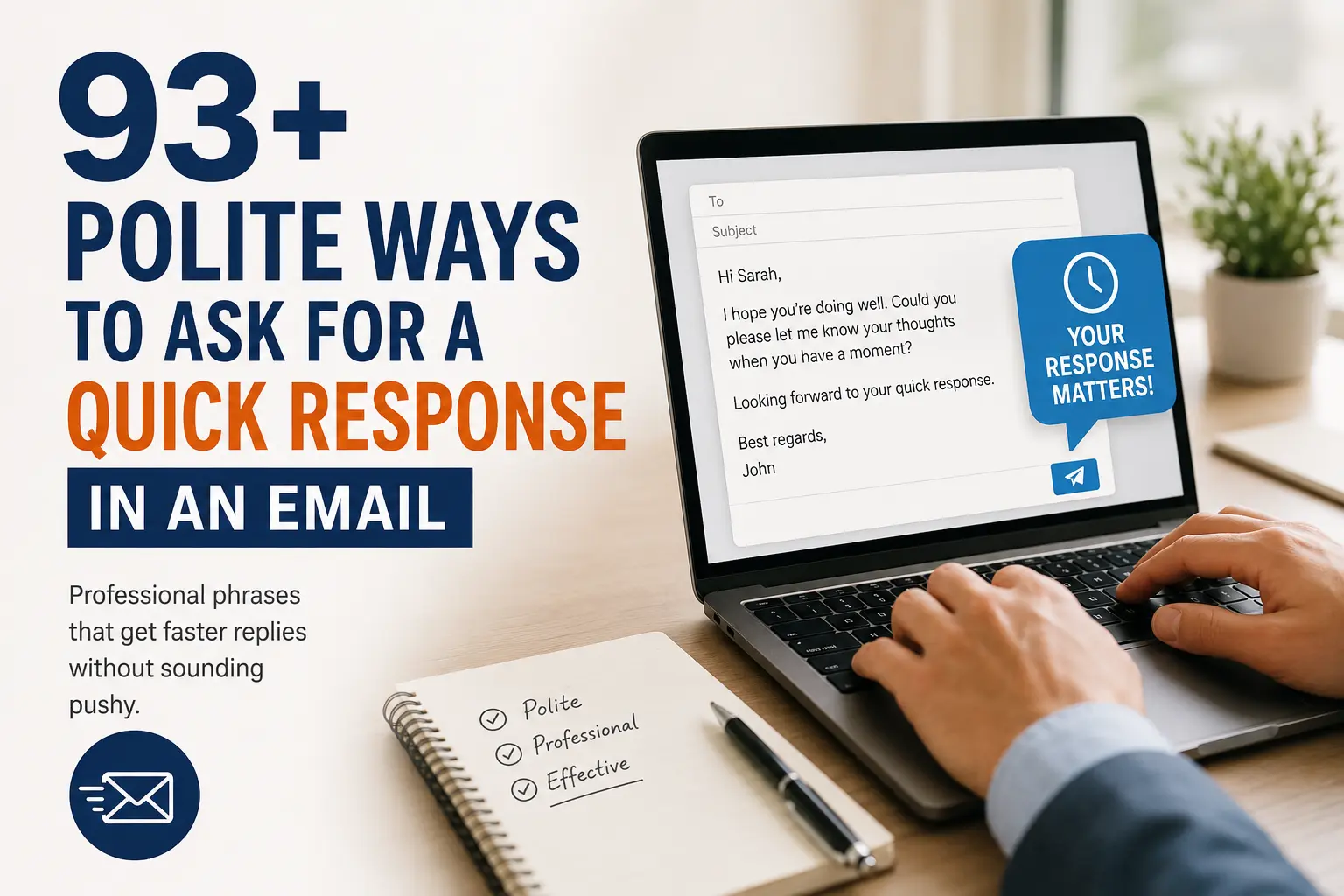
When you need an answer quickly, the way you ask can make all the difference. A direct request such as “Reply ASAP” may communicate urgency, but it can also sound demanding or impatient. Knowing polite ways to ask for a quick response in an email helps you balance urgency with professionalism, respect, and warmth. Whether you are following up with a client, requesting an approval from your manager, coordinating with a colleague, or checking on an important personal matter, the right wording can encourage a timely response without creating unnecessary pressure. Using thoughtful alternatives also makes your communication more natural and personal. Instead of repeating the same expression in every email, you can choose language that matches the relationship, situation, and level of urgency. The following alternatives will help you communicate time sensitive requests with confidence and courtesy.
What Does 93+ Polite Ways to Ask for a Quick Response in an Email Mean?
“Polite ways to ask for a quick response in an email” refers to courteous expressions used when you need someone to reply within a relatively short period.
The goal is not simply to demand an immediate answer. Instead, these expressions communicate that the matter is time sensitive while respecting the recipient’s schedule and priorities.
For example, you might write:
“I would appreciate your response at your earliest convenience.”
Or, when the situation is more urgent:
“If possible, could you please respond by the end of the day?”
The emotional tone can range from friendly and conversational to highly formal and businesslike. Choosing the right expression depends on your relationship with the recipient, the importance of the request, and your deadline.
When to Use It
Polite requests for quick responses are useful whenever waiting too long could delay a project, decision, meeting, approval, payment, appointment, or other important activity.
Workplace Emails
Use professional wording when contacting managers, clients, coworkers, suppliers, or business partners.
Example:
“I would appreciate your feedback as soon as your schedule permits.”
Follow Up Emails
When you have already sent a message and have not received a response, a courteous follow up can encourage action without sounding impatient.
Example:
“I wanted to follow up and see whether you have had a chance to review my previous email.”
Time Sensitive Requests
When a decision is needed before a specific deadline, clearly state the timeframe.
Example:
“Could you please let me know by Thursday so we can proceed with the next step?”
Casual Professional Communication
With familiar colleagues, you can use warmer and less formal expressions.
Example:
“When you get a moment, could you send me your thoughts?”
Client Communication
With customers and clients, polite urgency is especially important because you want to encourage action while maintaining a positive relationship.
Example:
“When convenient, we would appreciate your confirmation so we can finalize the arrangements.”
Is It Polite or Professional?
Yes. Asking for a quick response can be both polite and highly professional when the wording acknowledges the recipient’s time and avoids unnecessary pressure.
Expressions such as “at your earliest convenience,” “when you have a moment,” and “I would appreciate your prompt response” are suitable for professional correspondence.
However, phrases such as “Reply immediately,” “I need this now,” or “ASAP” can sound abrupt depending on the relationship and circumstances.
The most effective approach is to communicate three things clearly: what you need, when you need it, and why the response matters. When appropriate, giving a specific deadline is often more helpful than simply saying “quickly.”
93+ Polite Ways to Ask for a Quick Response in an Email
1. I would appreciate your prompt response.
Meaning: You are politely asking the recipient to respond soon.
Tone: Formal and professional.
“I would appreciate your prompt response so we can finalize the proposal.”
Why to use it: This is an excellent general purpose phrase for business correspondence.
2. I would appreciate a response at your earliest convenience.
Meaning: You would like an answer as soon as reasonably possible.
Tone: Formal and courteous.
“I would appreciate a response at your earliest convenience regarding the revised contract.”
Why to use it: Use this when urgency exists but you do not want to impose a strict deadline.
3. Could you please respond when you have a moment?
Meaning: You are asking for a response when the recipient has some available time.
Tone: Friendly and polite.
“Could you please respond when you have a moment and let me know your preference?”
Why to use it: Ideal for colleagues and familiar professional contacts.
4. When convenient, could you please get back to me?
Meaning: You would like the person to reply when their schedule allows.
Tone: Warm and professional.
“When convenient, could you please get back to me with your feedback?”
Why to use it: This expression sounds considerate while still encouraging a response.
5. I would be grateful for a quick response.
Meaning: You would sincerely appreciate receiving an answer soon.
Tone: Courteous and formal.
“I would be grateful for a quick response so that we can move forward.”
Why to use it: Suitable when you want your request to sound appreciative rather than demanding.
6. Could you kindly get back to me at your earliest convenience?
Meaning: You are respectfully asking for a timely reply.
Tone: Polished and formal.
“Could you kindly get back to me at your earliest convenience regarding the quotation?”
Why to use it: Particularly appropriate for clients, senior professionals, and formal correspondence.
7. I look forward to hearing from you soon.
Meaning: You expect or hope to receive a response shortly.
Tone: Professional and positive.
“I look forward to hearing from you soon regarding the proposed schedule.”
Why to use it: A natural closing that creates gentle urgency without pressure.
8. I look forward to your prompt response.
Meaning: You expect a timely answer.
Tone: Formal and businesslike.
“I look forward to your prompt response so we can complete the next stage.”
Why to use it: Best for professional situations where timing is important.
9. Please let me know at your earliest convenience.
Meaning: You would like the requested information soon.
Tone: Polite and professional.
“Please let me know at your earliest convenience whether the proposed date works for you.”
Why to use it: A versatile expression suitable for many workplace emails.
10. Please get back to me as soon as you can.
Meaning: You are asking for a relatively quick response.
Tone: Friendly and direct.
“Please get back to me as soon as you can so I can update the schedule.”
Why to use it: Appropriate for colleagues or people with whom you have an established relationship.
11. Could you please let me know as soon as possible?
Meaning: You need an answer soon.
Tone: Polite and direct.
“Could you please let me know as soon as possible whether you approve the changes?”
Why to use it: Use when timing matters and you want to make the urgency clear.
12. Your prompt attention to this matter would be appreciated.
Meaning: You are asking the recipient to address the matter soon.
Tone: Formal and authoritative.
“Your prompt attention to this matter would be appreciated as the deadline is approaching.”
Why to use it: Suitable for formal corporate correspondence.
13. I would appreciate your timely feedback.
Meaning: You need feedback within a reasonable timeframe.
Tone: Professional and concise.
“I would appreciate your timely feedback on the attached document.”
Why to use it: Excellent for reviews, approvals, and collaborative projects.
14. Could you please share your thoughts at your earliest convenience?
Meaning: You want the recipient’s opinion soon.
Tone: Warm and professional.
“Could you please share your thoughts at your earliest convenience?”
Why to use it: More personable than simply asking someone to reply.
15. I would value your response as soon as possible.
Meaning: The recipient’s answer is important to you and needed soon.
Tone: Respectful and professional.
“I would value your response as soon as possible so we can make an informed decision.”
Why to use it: This wording emphasizes the importance of the recipient’s input.
16. When you have a chance, please let me know.
Meaning: You would like an answer when the person becomes available.
Tone: Friendly and relaxed.
“When you have a chance, please let me know which option you prefer.”
Why to use it: Best for coworkers and informal professional communication.
17. I would appreciate hearing from you shortly.
Meaning: You hope to receive a response soon.
Tone: Formal and courteous.
“I would appreciate hearing from you shortly regarding the appointment.”
Why to use it: A polished alternative to “please reply soon.”
18. Could you please respond by [date]?
Meaning: You are setting a specific response deadline.
Tone: Clear and professional.
“Could you please respond by Friday so we can finalize the arrangements?”
Why to use it: Specific deadlines prevent ambiguity and help recipients prioritize the request.
19. Would you mind getting back to me today?
Meaning: You politely ask for a response during the current day.
Tone: Friendly and courteous.
“Would you mind getting back to me today if possible?”
Why to use it: Useful when you need a same day response without sounding forceful.
20. Could you kindly reply by the end of the day?
Meaning: You are requesting a response before the working day ends.
Tone: Formal and respectful.
“Could you kindly reply by the end of the day so we can proceed with the booking?”
Why to use it: Appropriate when a same day deadline is genuinely necessary.
21. I would be grateful if you could respond soon.
Meaning: You are respectfully requesting a timely response.
Tone: Courteous and formal.
“I would be grateful if you could respond soon regarding the outstanding details.”
Why to use it: This wording softens the request with appreciation.
22. May I kindly ask for your response at your earliest convenience?
Meaning: You politely ask the recipient to reply soon.
Tone: Highly formal.
“May I kindly ask for your response at your earliest convenience?”
Why to use it: Useful in formal correspondence with senior professionals or external contacts.
23. A timely response would help us move forward.
Meaning: A quick answer will prevent delays.
Tone: Professional and collaborative.
“A timely response would help us move forward with the implementation.”
Why to use it: This explains why you need a response rather than simply demanding one.
24. Your quick feedback would be greatly appreciated.
Meaning: You would be very thankful for a prompt opinion.
Tone: Warm and professional.
“Your quick feedback would be greatly appreciated before we submit the final version.”
Why to use it: Excellent for collaborative projects.
25. Could you please prioritize this when possible?
Meaning: You are asking the recipient to give the matter attention relatively soon.
Tone: Professional and tactful.
“Could you please prioritize this when possible so we can meet the project deadline?”
Why to use it: Useful when the request is important but not an emergency.
26. I would appreciate it if you could get back to me soon.
Meaning: You politely request a quick response.
Tone: Professional and friendly.
“I would appreciate it if you could get back to me soon with the updated figures.”
Why to use it: A versatile choice for everyday workplace communication.
27. Could you please provide an update when possible?
Meaning: You want current information soon.
Tone: Neutral and professional.
“Could you please provide an update when possible regarding the shipment?”
Why to use it: Ideal for project updates, orders, applications, and ongoing tasks.
28. I would welcome your response at your earliest opportunity.
Meaning: You would like an answer as soon as the recipient can reasonably provide one.
Tone: Formal and sophisticated.
“I would welcome your response at your earliest opportunity.”
Why to use it: A polished option for formal business writing.
29. Please let me know as soon as you are able.
Meaning: Respond when you are reasonably able to do so.
Tone: Considerate and professional.
“Please let me know as soon as you are able whether the revised terms are acceptable.”
Why to use it: This balances urgency with respect for the recipient’s workload.
30. I would appreciate a timely reply.
Meaning: You need the recipient to answer without unnecessary delay.
Tone: Formal and concise.
“I would appreciate a timely reply so that we can complete the paperwork.”
Why to use it: Excellent for short, professional emails.
31. Could you please respond when you get a chance?
Meaning: You want an answer when the person becomes available.
Tone: Friendly and casual professional.
“Could you please respond when you get a chance and confirm the meeting time?”
Why to use it: Natural for colleagues and familiar contacts.
32. Please share your confirmation as soon as possible.
Meaning: You need confirmation quickly.
Tone: Professional and direct.
“Please share your confirmation as soon as possible so we can reserve the venue.”
Why to use it: Particularly useful for bookings, approvals, and arrangements.
33. Could I kindly ask for a quick confirmation?
Meaning: You need confirmation soon.
Tone: Polite and formal.
“Could I kindly ask for a quick confirmation of your attendance?”
Why to use it: A graceful option when the required response is simple.
34. A prompt reply would help us stay on schedule.
Meaning: A quick response will prevent delays.
Tone: Collaborative and professional.
“A prompt reply would help us stay on schedule for the launch.”
Why to use it: It focuses on the shared objective instead of applying pressure.
35. Your response when convenient would be much appreciated.
Meaning: You would value a response when the recipient has time.
Tone: Warm and courteous.
“Your response when convenient would be much appreciated.”
Why to use it: Best when the matter is important but not extremely urgent.
36. I would be thankful for a response soon.
Meaning: You would appreciate hearing back shortly.
Tone: Warm and polite.
“I would be thankful for a response soon so I can make the necessary arrangements.”
Why to use it: A friendly alternative for less formal professional communication.
37. Could you please confirm at your earliest convenience?
Meaning: You want confirmation as soon as reasonably possible.
Tone: Professional and courteous.
“Could you please confirm at your earliest convenience whether the date works?”
Why to use it: Especially effective when you only need a yes or no answer.
38. Please advise when you have a moment.
Meaning: You are asking the recipient to provide guidance or information.
Tone: Concise and professional.
“Please advise when you have a moment on how you would like us to proceed.”
Why to use it: Commonly useful in business and administrative correspondence.
39. I would appreciate your guidance at your earliest convenience.
Meaning: You need the recipient’s advice soon.
Tone: Respectful and formal.
“I would appreciate your guidance at your earliest convenience regarding the next step.”
Why to use it: Ideal when writing to a manager, mentor, or senior colleague.
40. Could you please send your feedback when possible?
Meaning: You would like feedback soon, subject to the recipient’s availability.
Tone: Friendly and professional.
“Could you please send your feedback when possible?”
Why to use it: Suitable for documents, drafts, presentations, and creative work.
41. I would appreciate your thoughts as soon as possible.
Meaning: You want the recipient’s opinion soon.
Tone: Professional and collaborative.
“I would appreciate your thoughts as soon as possible before we finalize the strategy.”
Why to use it: Adds a personal and collaborative quality to the request.
42. Please respond at your earliest opportunity.
Meaning: You are requesting a timely answer.
Tone: Formal and businesslike.
“Please respond at your earliest opportunity regarding the attached proposal.”
Why to use it: A strong choice for formal correspondence.
43. Could you please get back to me by tomorrow?
Meaning: You need an answer no later than the following day.
Tone: Polite and direct.
“Could you please get back to me by tomorrow so I can complete the report?”
Why to use it: Specific timing makes the request easy to understand.
44. Would it be possible to receive your response today?
Meaning: You politely ask whether a same day response is feasible.
Tone: Courteous and professional.
“Would it be possible to receive your response today?”
Why to use it: This wording is especially considerate because it acknowledges that the deadline may require accommodation.
45. If possible, could you respond today?
Meaning: You would like a same day response if the recipient can manage it.
Tone: Gentle and respectful.
“If possible, could you respond today so we can finalize the itinerary?”
Why to use it: The phrase “if possible” softens urgency.
46. If you could respond soon, I would greatly appreciate it.
Meaning: You would be thankful for a prompt answer.
Tone: Warm and professional.
“If you could respond soon, I would greatly appreciate it.”
Why to use it: A useful choice when you want urgency to sound personal and appreciative.
47. When you have a moment, could you please confirm?
Meaning: You need confirmation when the recipient has time.
Tone: Friendly and considerate.
“When you have a moment, could you please confirm the revised appointment?”
Why to use it: Ideal for colleagues and familiar clients.
48. Please let me know your decision when possible.
Meaning: You want the recipient to communicate a decision soon.
Tone: Professional and neutral.
“Please let me know your decision when possible so we can prepare accordingly.”
Why to use it: Useful when waiting for approval or selection.
49. I would appreciate knowing your decision soon.
Meaning: You need to know what the recipient has decided.
Tone: Courteous and direct.
“I would appreciate knowing your decision soon so we can plan the next phase.”
Why to use it: Appropriate when the response will directly affect your next action.
50. Could you kindly provide your response by [date]?
Meaning: You are politely establishing a deadline.
Tone: Formal and precise.
“Could you kindly provide your response by Monday?”
Why to use it: Excellent for formal requests where timing must be explicit.
51. Your response by [date] would be greatly appreciated.
Meaning: You respectfully request an answer before a particular date.
Tone: Formal and courteous.
“Your response by Thursday would be greatly appreciated.”
Why to use it: Useful for external business communication and deadline driven projects.
52. I would be grateful for your confirmation today, if possible.
Meaning: You need confirmation today but recognize the recipient’s constraints.
Tone: Polite and considerate.
“I would be grateful for your confirmation today, if possible.”
Why to use it: An effective way to express urgency without sounding demanding.
53. Could you please help us by responding promptly?
Meaning: A quick response would support the team or project.
Tone: Collaborative and professional.
“Could you please help us by responding promptly so we can keep the process moving?”
Why to use it: This frames the request as teamwork.
54. Your prompt feedback will help us proceed.
Meaning: A quick response is necessary for the next step.
Tone: Professional and practical.
“Your prompt feedback will help us proceed with the final design.”
Why to use it: Explaining the benefit can make the request feel more reasonable.
55. A quick response would help us finalize the arrangements.
Meaning: Your answer will allow the arrangements to be completed.
Tone: Professional and collaborative.
“A quick response would help us finalize the arrangements for the event.”
Why to use it: Ideal for scheduling and logistical matters.
56. We would appreciate hearing from you soon.
Meaning: The organization or team would like a timely response.
Tone: Formal and courteous.
“We would appreciate hearing from you soon regarding your availability.”
Why to use it: Suitable for businesses communicating with clients or partners.
57. We would be grateful for your prompt reply.
Meaning: The team would sincerely appreciate a quick response.
Tone: Formal and respectful.
“We would be grateful for your prompt reply so we can finalize the order.”
Why to use it: Appropriate for formal corporate correspondence.
58. Please let us know as soon as you can.
Meaning: The sender needs information soon.
Tone: Friendly and professional.
“Please let us know as soon as you can whether the proposed arrangement is acceptable.”
Why to use it: A natural option for business teams and customer communication.
59. We would appreciate your timely confirmation.
Meaning: You want confirmation without unnecessary delay.
Tone: Professional and polished.
“We would appreciate your timely confirmation of the booking.”
Why to use it: Particularly suitable for business transactions and scheduling.
60. Could you please provide an answer at your earliest convenience?
Meaning: You politely request an answer soon.
Tone: Formal and courteous.
“Could you please provide an answer at your earliest convenience?”
Why to use it: A dependable expression for formal business writing.
61. I would appreciate a response as soon as your schedule allows.
Meaning: You want an answer soon while recognizing the recipient’s workload.
Tone: Considerate and professional.
“I would appreciate a response as soon as your schedule allows.”
Why to use it: Excellent when contacting busy professionals.
62. When your schedule permits, please let me know.
Meaning: Respond when your workload allows.
Tone: Respectful and warm.
“When your schedule permits, please let me know your preferred meeting time.”
Why to use it: This expression demonstrates consideration for the recipient.
63. At your earliest opportunity, could you please confirm?
Meaning: You want confirmation as soon as reasonably possible.
Tone: Formal and refined.
“At your earliest opportunity, could you please confirm your availability?”
Why to use it: A sophisticated option for professional emails.
64. I would welcome a prompt response.
Meaning: You would be pleased to receive an answer soon.
Tone: Professional and polished.
“I would welcome a prompt response so we can determine the next steps.”
Why to use it: A concise alternative to more conventional expressions.
65. Your prompt reply would enable us to proceed.
Meaning: A quick answer is necessary to continue.
Tone: Formal and businesslike.
“Your prompt reply would enable us to proceed with the application.”
Why to use it: Particularly effective when the recipient’s response is a prerequisite.
66. A timely reply would allow us to move ahead.
Meaning: Your response will prevent the process from being delayed.
Tone: Professional and collaborative.
“A timely reply would allow us to move ahead with the project.”
Why to use it: Communicates urgency through practical consequences.
67. Could you please help us keep things moving by responding soon?
Meaning: A quick response will maintain progress.
Tone: Friendly and collaborative.
“Could you please help us keep things moving by responding soon?”
Why to use it: Great for teamwork and project coordination.
68. Your feedback at your earliest convenience would be invaluable.
Meaning: Your input is highly useful and requested soon.
Tone: Appreciative and professional.
“Your feedback at your earliest convenience would be invaluable as we refine the proposal.”
Why to use it: Adds warmth and emphasizes the importance of the recipient’s expertise.
69. Could you please share an update when you can?
Meaning: You would like current information soon.
Tone: Friendly and natural.
“Could you please share an update when you can?”
Why to use it: Excellent for informal workplace conversations.
70. I would appreciate an update at your earliest convenience.
Meaning: You need updated information soon.
Tone: Formal and professional.
“I would appreciate an update at your earliest convenience regarding the application.”
Why to use it: Suitable for follow ups and ongoing processes.
71. Please keep me posted as soon as you have an update.
Meaning: Tell me promptly when new information becomes available.
Tone: Friendly and professional.
“Please keep me posted as soon as you have an update from the supplier.”
Why to use it: Useful when an immediate response is not possible but updates are important.
72. Could you please touch base with me soon?
Meaning: You want the person to contact you shortly.
Tone: Friendly and conversational.
“Could you please touch base with me soon so we can discuss the next steps?”
Why to use it: Best for familiar colleagues and professional contacts.
73. I would appreciate it if you could confirm as soon as possible.
Meaning: You need confirmation quickly.
Tone: Polite and professional.
“I would appreciate it if you could confirm as soon as possible.”
Why to use it: A versatile expression for scheduling and decision making.
74. Could you please let me know by the close of business?
Meaning: You want a response before the working day ends.
Tone: Formal and businesslike.
“Could you please let me know by the close of business whether the proposal is approved?”
Why to use it: Useful in corporate environments where “close of business” is understood.
75. Would you be able to respond before the deadline?
Meaning: You ask whether the person can reply before a specific cutoff.
Tone: Respectful and professional.
“Would you be able to respond before the deadline on Friday?”
Why to use it: A tactful way to check availability without issuing a command.
76. Could you please send your decision before [date]?
Meaning: You need a decision by a specific date.
Tone: Clear and professional.
“Could you please send your decision before Tuesday?”
Why to use it: Particularly useful for approvals and time sensitive choices.
77. I would appreciate your input before we proceed.
Meaning: You need the recipient’s opinion before taking the next step.
Tone: Collaborative and professional.
“I would appreciate your input before we proceed with the final submission.”
Why to use it: This approach makes the request purposeful rather than simply urgent.
78. Could you please review this at your earliest convenience?
Meaning: You want the recipient to review something soon.
Tone: Professional and courteous.
“Could you please review this at your earliest convenience and share any comments?”
Why to use it: Excellent for documents, proposals, reports, and drafts.
79. I would appreciate your review as soon as possible.
Meaning: You need the recipient to review something quickly.
Tone: Formal and direct.
“I would appreciate your review as soon as possible because the submission deadline is approaching.”
Why to use it: Appropriate when review time is limited.
80. When you have a moment, could you take a look and let me know?
Meaning: You want someone to review something and respond.
Tone: Friendly and conversational.
“When you have a moment, could you take a look and let me know what you think?”
Why to use it: A natural choice for colleagues and familiar contacts.
81. Could you please give me a quick confirmation?
Meaning: You only need a brief confirmation.
Tone: Friendly and direct.
“Could you please give me a quick confirmation that you received the documents?”
Why to use it: Helpful when the recipient can respond with minimal effort.
82. A brief confirmation would be greatly appreciated.
Meaning: You only require a short response.
Tone: Formal and courteous.
“A brief confirmation would be greatly appreciated once you have reviewed the details.”
Why to use it: This makes the request feel manageable and specific.
83. Could you please acknowledge receipt when possible?
Meaning: You want the recipient to confirm that they received something.
Tone: Formal and professional.
“Could you please acknowledge receipt when possible?”
Why to use it: Useful for important documents, applications, and formal submissions.
84. Please confirm receipt at your earliest convenience.
Meaning: You want confirmation that the message or document arrived.
Tone: Formal and polished.
“Please confirm receipt at your earliest convenience so we know the documents reached you.”
Why to use it: Appropriate for formal business and administrative correspondence.
85. Could you please let me know whether this works for you?
Meaning: You need a quick decision or confirmation.
Tone: Friendly and professional.
“Could you please let me know whether Thursday works for you?”
Why to use it: A natural way to request a simple response.
86. I would appreciate knowing whether this is acceptable.
Meaning: You need confirmation about approval or agreement.
Tone: Formal and respectful.
“I would appreciate knowing whether this is acceptable before we proceed.”
Why to use it: Particularly useful for formal approvals.
87. Please let me know your preference when you can.
Meaning: You want the recipient to select an option soon.
Tone: Friendly and professional.
“Please let me know your preference when you can so I can make the reservation.”
Why to use it: Ideal for scheduling, planning, and decision making.
88. Could you kindly share your preference by tomorrow?
Meaning: You need the recipient’s choice by the next day.
Tone: Polite and professional.
“Could you kindly share your preference by tomorrow so we can finalize the arrangements?”
Why to use it: Combines a courteous request with a clear deadline.
89. I would appreciate your confirmation as soon as practical.
Meaning: You want confirmation when it is reasonably possible.
Tone: Professional and measured.
“I would appreciate your confirmation as soon as practical.”
Why to use it: Useful when you want urgency without suggesting an emergency.
90. Could you please respond as soon as your schedule permits?
Meaning: You want a response while respecting the recipient’s commitments.
Tone: Highly considerate and professional.
“Could you please respond as soon as your schedule permits?”
Why to use it: Excellent when communicating with busy executives or clients.
91. I would be grateful for your reply when you have an opportunity.
Meaning: You would appreciate a response when the recipient has time.
Tone: Warm and formal.
“I would be grateful for your reply when you have an opportunity.”
Why to use it: A gentle expression that avoids sounding demanding.
92. Please respond when you are able so we can proceed.
Meaning: You need an answer to continue the process.
Tone: Professional and collaborative.
“Please respond when you are able so we can proceed with the next stage.”
Why to use it: Balances flexibility with a clear reason for the request.
93. Your response soon would help us finalize the next steps.
Meaning: A quick answer will allow the process to continue.
Tone: Professional and practical.
“Your response soon would help us finalize the next steps.”
Why to use it: Good for projects, approvals, and internal coordination.
94. Could you please get back to me as soon as reasonably possible?
Meaning: You want a prompt response without demanding immediate action.
Tone: Polite and professional.
“Could you please get back to me as soon as reasonably possible regarding the revised timeline?”
Why to use it: This is especially useful when the matter is important but you want to remain considerate.
95. I would appreciate your response within the next day or two.
Meaning: You are giving a flexible short timeframe for the response.
Tone: Friendly and professional.
“I would appreciate your response within the next day or two so we can organize the schedule.”
Why to use it: Helpful when you need a relatively quick answer but do not require a same day response.
96. If you could get back to me by [date], that would be very helpful.
Meaning: You politely establish a preferred deadline.
Tone: Warm and collaborative.
“If you could get back to me by Wednesday, that would be very helpful.”
Why to use it: This sounds less demanding than simply ordering someone to respond by a deadline.
97. A response by [date] would help us plan accordingly.
Meaning: Your answer will help with planning.
Tone: Professional and practical.
“A response by Friday would help us plan accordingly.”
Why to use it: Ideal when the deadline is connected to scheduling or resource planning.
98. I hope you can get back to me soon.
Meaning: You express a courteous hope for a timely response.
Tone: Warm and friendly.
“I hope you can get back to me soon so we can discuss the available options.”
Why to use it: Suitable for less formal professional relationships and personal correspondence.
How to Choose the Right Phrase
The best expression depends on three factors: urgency, relationship, and context.
For a formal business email, phrases such as “I would appreciate your prompt response” or “Please respond at your earliest opportunity” are appropriate.
For a colleague, “When you have a moment, could you please let me know?” sounds more natural.
For a strict deadline, use a specific date or time. For example, “Could you please respond by Thursday?” is clearer than simply saying “Please reply soon.”
You should also consider whether the recipient is senior to you, a client, a coworker, or someone you know personally. The closer the relationship, the more conversational your wording can become.
Most importantly, avoid creating artificial urgency. If the matter is not genuinely time sensitive, giving the recipient reasonable flexibility will make your communication more respectful.
Conclusion
Knowing how to ask for a quick response without sounding demanding is an important professional communication skill. The right phrase can transform an urgent request into a respectful, collaborative message. These 93+ polite ways to ask for a quick response in an email alternatives give you options for formal business correspondence, friendly workplace conversations, client follow ups, deadlines, confirmations, and everyday requests. Instead of relying repeatedly on “ASAP,” choose language that reflects your relationship with the recipient and the urgency of the situation. Experiment with different expressions naturally, and whenever possible, provide a clear deadline and a brief reason for your request. Thoughtful wording encourages faster responses while preserving professionalism and goodwill.
Discover more.