
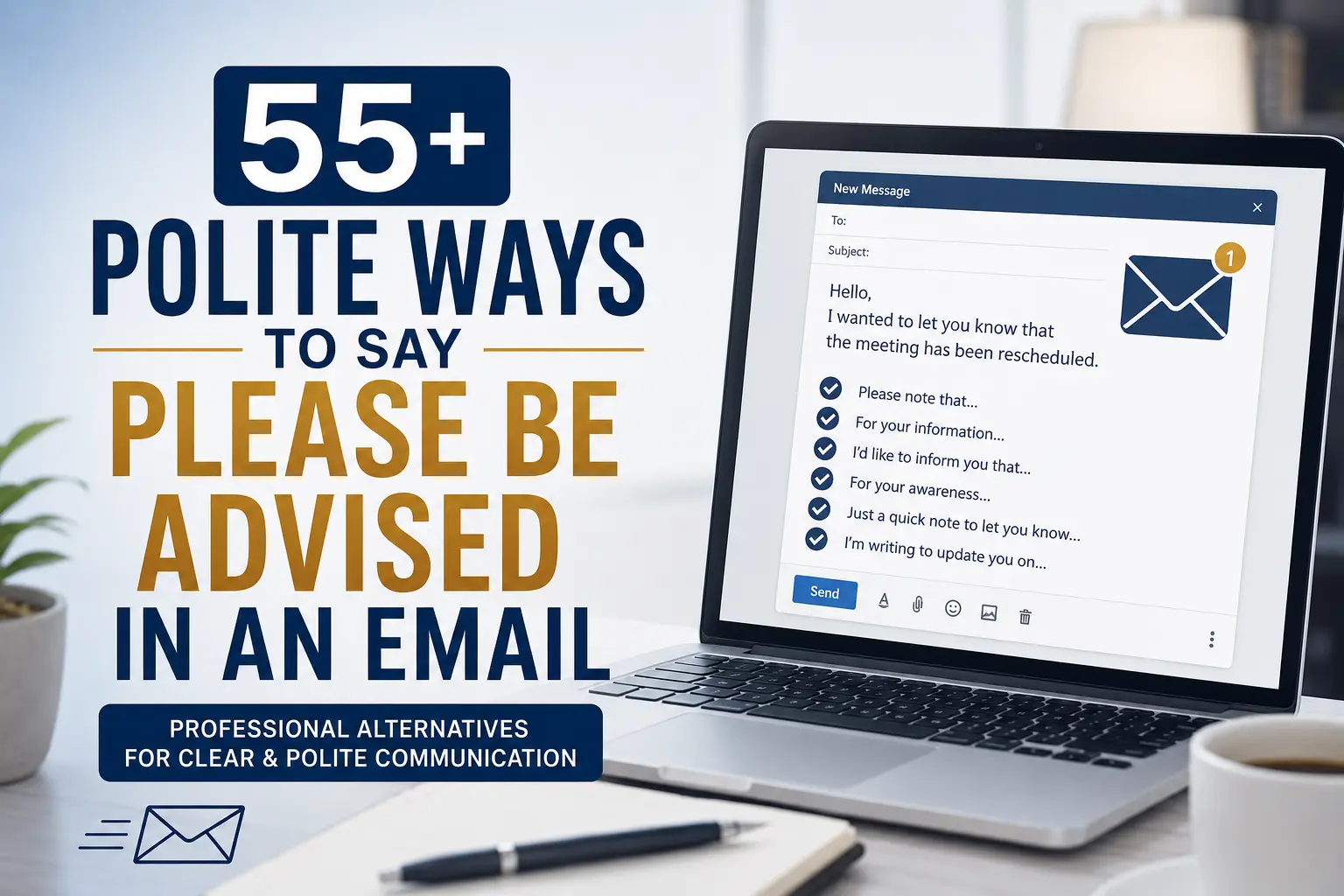
The phrase “please be advised” is common in professional emails, but using it too often can make your writing sound formal, distant, or repetitive. Whether you are sharing an important update, notifying a colleague about a change, or drawing attention to a specific detail, the words you choose can influence how your message is received. Fortunately, there are many polite and professional alternatives that can make your emails sound more natural and engaging. Choosing the right expression allows you to communicate important information without sounding overly rigid or impersonal. In this guide, you will discover more than 55 polite ways to say “please be advised” in an email, along with meanings, tones, examples, and explanations. These alternatives can help you tailor your communication to different professional, workplace, customer service, and casual situations.
What Does “Please Be Advised” Mean?
“Please be advised” is a formal expression used to tell someone that important information is being provided and should be noticed or taken into consideration.
For example:
Please be advised that the office will remain closed on Friday.
The phrase generally has a serious, formal, and informative tone. It is frequently used in business correspondence, official notices, customer service messages, workplace announcements, and administrative communication.
Although “please be advised” is grammatically correct and professional, it can sometimes sound stiff or impersonal. Depending on your audience and the nature of your message, a warmer alternative may communicate the same information more effectively.
When to Use “Please Be Advised”
“Please be advised” is most appropriate when you need to emphasize information that the recipient should know.
Formal Emails
Use it when communicating official information.
Please be advised that your application has been received.
Workplace Communication
It can introduce an important operational update.
Please be advised that the meeting room has been changed to Room 204.
Customer Service
It can be used to communicate policies, deadlines, or service changes.
Please be advised that processing may take up to five business days.
Official Notices
The phrase works well when the message has an administrative or regulatory purpose.
Please be advised that all visitors must register at reception.
Casual Professional Emails
For colleagues or familiar contacts, a warmer alternative may sound more natural.
Just a quick note to let you know that tomorrow’s meeting has been moved.
Is “Please Be Advised” Polite or Professional?
Yes, “please be advised” is both polite and professional. However, its tone is generally more formal than conversational. It can sometimes sound authoritative, particularly when used to communicate rules, warnings, deadlines, or policy changes.
In modern workplace communication, alternatives such as “please note,” “I wanted to let you know,” “just a quick update,” and “for your awareness” often sound more approachable while remaining professional.
The best choice depends on your relationship with the recipient, the importance of the information, and the tone you want to establish.
55+ Other Ways to Say “Please Be Advised” in an Email
1. Please Note
Meaning: This asks the recipient to pay attention to the information that follows.
Tone: Formal, professional, neutral
Please note that the submission deadline has been extended until Monday.
Why and when to use it: Use this as one of the simplest replacements for “please be advised” when you want to highlight important information without sounding overly formal.
Purpose and Personalization: It works particularly well in workplace announcements, instructions, and administrative emails.
2. Kindly Note
Meaning: A courteous request for the recipient to pay attention to specific information.
Tone: Polite, formal, respectful
Kindly note that all invoices must include the purchase order number.
Why and when to use it: Choose this expression when you want your email to sound courteous while retaining a formal business tone.
Purpose and Personalization: It is especially suitable for clients, vendors, and professional correspondence.
3. Please Be Aware
Meaning: This alerts someone to information they should know or consider.
Tone: Professional, considerate
Please be aware that the building will be inaccessible during maintenance.
Why and when to use it: It is useful when the information could affect the recipient’s plans or actions.
Purpose and Personalization: This expression sounds slightly more conversational than “please be advised.”
4. Please Keep in Mind
Meaning: This asks someone to remember or consider a particular point.
Tone: Friendly, professional
Please keep in mind that delivery times may vary during the holiday season.
Why and when to use it: Use it when providing guidance, expectations, or considerations rather than simply announcing information.
Purpose and Personalization: It adds warmth to professional communication.
5. For Your Information
Meaning: This indicates that information is being provided for the recipient’s knowledge.
Tone: Formal, neutral
For your information, the revised policy will take effect next month.
Why and when to use it: It works well when no immediate action is required.
Purpose and Personalization: It is ideal for informational updates and internal business communication.
6. For Your Awareness
Meaning: This means the recipient should be aware of the information.
Tone: Professional, polished
For your awareness, the project schedule has been updated.
Why and when to use it: Use this when sharing information that may become relevant later.
Purpose and Personalization: It sounds professional without being unnecessarily stern.
7. I Wanted to Let You Know
Meaning: A friendly way to introduce important information.
Tone: Warm, professional, conversational
I wanted to let you know that your appointment has been rescheduled.
Why and when to use it: This is excellent for emails where you want to sound personable and considerate.
Purpose and Personalization: It creates a human connection that “please be advised” sometimes lacks.
8. I’d Like to Inform You
Meaning: This formally introduces information the recipient should know.
Tone: Formal, polished
I’d like to inform you that your request has been approved.
Why and when to use it: Use this in formal business correspondence, especially when communicating decisions or official updates.
Purpose and Personalization: It gives your message a refined and professional character.
9. I’m Writing to Inform You
Meaning: This clearly states the purpose of the email.
Tone: Formal, direct
I’m writing to inform you that the scheduled inspection has been postponed.
Why and when to use it: Use it when the primary purpose of your email is to communicate an important update.
Purpose and Personalization: It is suitable for formal notices and organizational correspondence.
10. I’d Like to Bring to Your Attention
Meaning: This asks the recipient to focus on a particular matter.
Tone: Formal, respectful
I’d like to bring to your attention a change to our payment terms.
Why and when to use it: Use this when the information requires particular consideration.
Purpose and Personalization: It works well when addressing important details without sounding confrontational.
11. Please Take Note
Meaning: This emphasizes that the information should be noticed and remembered.
Tone: Formal, authoritative
Please take note of the revised submission requirements.
Why and when to use it: Choose this when communicating instructions or procedural changes.
Purpose and Personalization: It is particularly effective for internal policies and deadlines.
12. Please Take Notice
Meaning: This formally draws attention to information.
Tone: Formal, official
Please take notice that the premises will be closed after 5 p.m.
Why and when to use it: Use it primarily in official or administrative communication.
Purpose and Personalization: It has a stronger formal character than most conversational alternatives.
13. We Would Like to Inform You
Meaning: A formal way for an organization to communicate an update.
Tone: Formal, corporate
We would like to inform you that our service hours have changed.
Why and when to use it: This is ideal when writing on behalf of a company or department.
Purpose and Personalization: It presents information professionally while maintaining an institutional voice.
14. This Is to Inform You
Meaning: A direct statement introducing official information.
Tone: Formal, administrative
This is to inform you that your membership will expire on December 31.
Why and when to use it: Use this for official notices and formal correspondence.
Purpose and Personalization: It is concise and appropriate when clarity is more important than warmth.
15. We Wish to Inform You
Meaning: A formal expression used to announce information.
Tone: Formal, courteous
We wish to inform you that the application period has now closed.
Why and when to use it: It is appropriate for institutional communication.
Purpose and Personalization: It gives notices a polished and respectful tone.
16. Kindly Be Aware
Meaning: A polite request for someone to recognize or consider information.
Tone: Formal, courteous
Kindly be aware that additional documentation may be required.
Why and when to use it: Use it when you want to alert someone without sounding demanding.
Purpose and Personalization: It is useful for customer service and professional correspondence.
17. Please Be Mindful
Meaning: This encourages someone to consider something carefully.
Tone: Respectful, considerate
Please be mindful of the revised office access procedures.
Why and when to use it: Use it when the information involves behavior, timing, or consideration for others.
Purpose and Personalization: It has a softer tone than a strict instruction.
18. Please Bear in Mind
Meaning: This asks someone to remember a relevant fact or condition.
Tone: Professional, thoughtful
Please bear in mind that delivery dates may change depending on availability.
Why and when to use it: It is useful when explaining limitations or circumstances.
Purpose and Personalization: This expression sounds natural in polished business writing.
19. It Is Important to Note
Meaning: This emphasizes that particular information deserves attention.
Tone: Formal, authoritative
It is important to note that refunds are subject to our return policy.
Why and when to use it: Use it when communicating a significant condition or qualification.
Purpose and Personalization: It gives important details greater emphasis.
20. It May Be Helpful to Know
Meaning: A gentle way to introduce potentially useful information.
Tone: Friendly, helpful
It may be helpful to know that the support team is available seven days a week.
Why and when to use it: Use it when you want to inform rather than instruct.
Purpose and Personalization: It is particularly effective in customer service and supportive communication.
21. I’d Like to Highlight
Meaning: This draws attention to a particular point.
Tone: Professional, confident
I’d like to highlight the updated requirements outlined below.
Why and when to use it: Use it when emphasizing a key detail in a longer email.
Purpose and Personalization: It helps readers quickly identify important information.
22. I’d Like to Draw Your Attention to
Meaning: This politely directs the recipient toward a specific issue or detail.
Tone: Formal, respectful
I’d like to draw your attention to the changes in the attached document.
Why and when to use it: Use this for important professional matters requiring careful review.
Purpose and Personalization: It sounds sophisticated and diplomatic.
23. Please Keep This in Mind
Meaning: This asks the recipient to remember specific information.
Tone: Friendly, professional
Please keep this in mind when preparing next month’s schedule.
Why and when to use it: Use it when information will influence a future decision.
Purpose and Personalization: It is warmer and more conversational than “please be advised.”
24. I’d Like You to Be Aware
Meaning: This directly but politely alerts someone to information.
Tone: Professional, considerate
I’d like you to be aware of the updated project requirements.
Why and when to use it: Use it when communicating information that may affect the recipient.
Purpose and Personalization: It creates a more personal tone.
25. Just a Quick Note to Let You Know
Meaning: A casual professional introduction to a brief update.
Tone: Friendly, casual professional
Just a quick note to let you know that tomorrow’s meeting will begin at 10 a.m.
Why and when to use it: Use this with colleagues, familiar clients, or professional contacts.
Purpose and Personalization: It makes routine updates sound approachable.
26. A Quick Update
Meaning: A concise introduction to new or changed information.
Tone: Friendly, concise
A quick update: the launch date has been moved to June 15.
Why and when to use it: Use it for short workplace messages.
Purpose and Personalization: It is excellent when brevity matters.
27. Just to Keep You Updated
Meaning: This indicates that you are sharing the latest information.
Tone: Friendly, professional
Just to keep you updated, the client has approved the revised proposal.
Why and when to use it: Use it for progress reports and ongoing projects.
Purpose and Personalization: It makes communication feel collaborative.
28. I Wanted to Keep You Informed
Meaning: This explains that you are providing information so the recipient remains updated.
Tone: Warm, professional
I wanted to keep you informed about the latest changes to the schedule.
Why and when to use it: Use it when maintaining transparency is important.
Purpose and Personalization: It demonstrates consideration for the recipient.
29. I’m Reaching Out to Let You Know
Meaning: A friendly introduction to an update or announcement.
Tone: Warm, conversational
I’m reaching out to let you know that your order is ready for collection.
Why and when to use it: Use it in customer service and relationship focused emails.
Purpose and Personalization: It sounds more personal than a formal notice.
30. Please Be Informed
Meaning: A formal request that the recipient recognize the information being provided.
Tone: Formal, official
Please be informed that the office will operate on reduced hours tomorrow.
Why and when to use it: Use it for official workplace or administrative notices.
Purpose and Personalization: It is best reserved for formal contexts.
31. For Your Attention
Meaning: This indicates that the recipient should review or consider something.
Tone: Formal, direct
For your attention, the attached document requires your signature.
Why and when to use it: Use it when action or review is expected.
Purpose and Personalization: It is concise and particularly effective in document related emails.
32. For Your Consideration
Meaning: This presents information for someone to review or evaluate.
Tone: Formal, respectful
For your consideration, I have attached an alternative proposal.
Why and when to use it: Use it when presenting ideas, proposals, or recommendations.
Purpose and Personalization: It creates a respectful tone that avoids sounding demanding.
33. Please Consider the Following
Meaning: This introduces information that requires thought or evaluation.
Tone: Professional, formal
Please consider the following changes before submitting the final report.
Why and when to use it: Use it when explaining requirements, recommendations, or options.
Purpose and Personalization: It works well in detailed professional emails.
34. We Would Like to Bring to Your Attention
Meaning: A formal way to highlight an important matter.
Tone: Corporate, formal
We would like to bring to your attention a recent change to our privacy policy.
Why and when to use it: Use it for official communications sent on behalf of an organization.
Purpose and Personalization: It conveys importance without using overly forceful language.
35. I’d Like to Make You Aware
Meaning: This politely tells someone about a relevant situation.
Tone: Professional, considerate
I’d like to make you aware of a minor change to the project timeline.
Why and when to use it: Use it when transparency and clarity are priorities.
Purpose and Personalization: It is appropriate for workplace updates and client communication.
36. I Want to Make You Aware
Meaning: A direct statement used to alert someone to information.
Tone: Direct, professional
I want to make you aware that the contract requires renewal next month.
Why and when to use it: Use it when the information is important and should not be overlooked.
Purpose and Personalization: It is more direct than “I wanted to let you know.”
37. Please Take Into Consideration
Meaning: This asks the recipient to factor specific information into a decision.
Tone: Formal, respectful
Please take into consideration the revised budget when planning the next phase.
Why and when to use it: Use it when communicating recommendations or constraints.
Purpose and Personalization: It is particularly effective in managerial and planning contexts.
38. I’d Like to Share an Important Update
Meaning: This introduces information that may be significant to the recipient.
Tone: Warm, professional
I’d like to share an important update regarding the upcoming conference.
Why and when to use it: Use it when you want to combine professionalism with a friendly tone.
Purpose and Personalization: It works well for team announcements and client updates.
39. I’m Pleased to Inform You
Meaning: This introduces positive or welcome information.
Tone: Formal, positive
I’m pleased to inform you that your proposal has been approved.
Why and when to use it: Use it when delivering good news or favorable decisions.
Purpose and Personalization: It adds warmth and positivity to formal communication.
40. I Regret to Inform You
Meaning: This introduces disappointing or unfavorable information.
Tone: Formal, respectful
I regret to inform you that your application was unsuccessful.
Why and when to use it: Use it when communicating sensitive negative news.
Purpose and Personalization: It demonstrates professionalism and consideration.
41. Please Be Mindful of
Meaning: This encourages careful consideration of a specific matter.
Tone: Respectful, thoughtful
Please be mindful of the revised deadline when submitting your documents.
Why and when to use it: Use it when a gentle reminder is more appropriate than a firm warning.
Purpose and Personalization: It is useful for workplace etiquette and deadlines.
42. A Gentle Reminder That
Meaning: This politely reminds someone about information or an obligation.
Tone: Friendly, courteous
A gentle reminder that all expense reports are due by Friday.
Why and when to use it: Use it for deadlines, appointments, payments, and pending tasks.
Purpose and Personalization: It communicates urgency without sounding aggressive.
43. Please Remember That
Meaning: This asks the recipient not to forget important information.
Tone: Friendly, direct
Please remember that all visitors must sign in at reception.
Why and when to use it: Use it for reminders and recurring procedures.
Purpose and Personalization: It is simple and accessible for everyday workplace communication.
44. Please Keep in View
Meaning: This asks someone to keep a matter in consideration.
Tone: Formal, thoughtful
Please keep the revised budget in view when making your recommendations.
Why and when to use it: Use it when a factor should remain relevant during decision making.
Purpose and Personalization: It gives professional writing a polished tone.
45. As a Reminder
Meaning: This introduces information that the recipient may already know but should remember.
Tone: Neutral, professional
As a reminder, the registration deadline is next Tuesday.
Why and when to use it: Use it when following up on previously communicated information.
Purpose and Personalization: It is concise and useful for routine business correspondence.
46. To Keep You Informed
Meaning: This introduces information intended to maintain transparency.
Tone: Professional, considerate
To keep you informed, the repair work is expected to finish tomorrow.
Why and when to use it: Use it when providing status updates.
Purpose and Personalization: It reinforces openness and good communication.
47. For Context
Meaning: This introduces background information that helps the recipient understand a situation.
Tone: Modern, professional
For context, the original timeline was based on a June launch.
Why and when to use it: Use it when additional information is necessary to understand an update.
Purpose and Personalization: It works especially well in concise workplace emails.
48. For Reference
Meaning: This provides information that the recipient may need to consult later.
Tone: Professional, neutral
For reference, I have attached the updated pricing schedule.
Why and when to use it: Use it when sending documents, figures, policies, or records.
Purpose and Personalization: It is useful when no immediate response is required.
49. It Is Worth Noting
Meaning: This indicates that a particular detail deserves attention.
Tone: Polished, professional
It is worth noting that the revised proposal includes additional support.
Why and when to use it: Use it when highlighting a meaningful detail without sounding forceful.
Purpose and Personalization: It gives business writing a sophisticated and measured tone.
50. I’d Like to Clarify
Meaning: This introduces information intended to remove confusion or misunderstanding.
Tone: Professional, diplomatic
I’d like to clarify that the quoted price does not include installation.
Why and when to use it: Use it when correcting assumptions or explaining details.
Purpose and Personalization: It is particularly useful when handling potentially sensitive communication.
51. To Clarify
Meaning: This introduces a clarification or correction.
Tone: Direct, professional
To clarify, the final report is due by Thursday, not Friday.
Why and when to use it: Use it when you want to eliminate ambiguity quickly.
Purpose and Personalization: It is concise and effective in workplace communication.
52. I’d Like to Update You
Meaning: This tells the recipient that you are providing new information.
Tone: Friendly, professional
I’d like to update you on the progress of the recruitment process.
Why and when to use it: Use it for project updates, applications, customer service, and ongoing discussions.
Purpose and Personalization: It sounds collaborative and transparent.
53. I’m Writing to Bring an Important Matter to Your Attention
Meaning: This formally introduces an issue that requires awareness.
Tone: Formal, serious, respectful
I’m writing to bring an important matter to your attention regarding the contract renewal.
Why and when to use it: Use it when the subject deserves careful consideration.
Purpose and Personalization: It is appropriate for sensitive or high importance business communication.
54. Please Be Guided Accordingly
Meaning: This asks the recipient to use the information when deciding what to do next.
Tone: Formal, official
Please be guided accordingly by the updated compliance requirements.
Why and when to use it: Use it in highly formal administrative or organizational correspondence.
Purpose and Personalization: It should generally be reserved for formal settings because it can sound authoritative.
55. Please Act Accordingly
Meaning: This asks the recipient to take appropriate action based on the information provided.
Tone: Formal, direct
Please act accordingly following the revised safety procedures.
Why and when to use it: Use it when the information requires action rather than simple awareness.
Purpose and Personalization: It is stronger than “please note,” so use it when an action is genuinely expected.
56. Please Take This Into Account
Meaning: This asks someone to consider the information when making a decision.
Tone: Professional, considerate
Please take this into account when preparing the final budget.
Why and when to use it: Use it when explaining factors that may influence a decision.
Purpose and Personalization: It sounds natural and collaborative in modern business writing.
57. I Wanted to Bring This to Your Attention
Meaning: This politely highlights a particular issue or piece of information.
Tone: Warm, professional, diplomatic
I wanted to bring this to your attention before we finalize the agreement.
Why and when to use it: Use it when you want to sound respectful while discussing an important matter.
Purpose and Personalization: It is particularly effective when communicating with managers, clients, or colleagues.
58. Please Keep Yourself Updated
Meaning: This encourages someone to remain informed about developments.
Tone: Professional, friendly
Please keep yourself updated through the project portal for further announcements.
Why and when to use it: Use it when information may change over time.
Purpose and Personalization: It works well for projects involving frequent updates.
59. I’d Like to Keep You Posted
Meaning: This means you intend to keep someone informed as developments occur.
Tone: Friendly, conversational
I’d like to keep you posted as we receive further information.
Why and when to use it: Use it with colleagues, clients, or professional contacts with whom you have an established relationship.
Purpose and Personalization: It creates a friendly and collaborative impression.
60. Please Stay Informed
Meaning: This encourages the recipient to remain aware of future developments.
Tone: Professional, neutral
Please stay informed of any additional changes through our official communication channels.
Why and when to use it: Use it when information is likely to evolve.
Purpose and Personalization: It is suitable for ongoing projects, events, and organizational updates.
How to Choose the Best Alternative
The best alternative to “please be advised” depends on what you want your email to accomplish.
If you simply want to share information, “please note” or “for your information” works well. If you want to sound warmer, consider “I wanted to let you know” or “I wanted to keep you informed.”
For sensitive matters, “I’d like to bring this to your attention” can sound diplomatic. When action is required, “please take this into account” or “please act accordingly” may be more appropriate.
For casual workplace communication, expressions such as “just a quick note” and “a quick update” can make your message feel more natural.
The goal is not simply to replace one phrase with another. The goal is to select language that matches your relationship with the reader, the seriousness of the information, and the action you expect.
Conclusion
Using alternatives to “please be advised” can make professional emails clearer, warmer, and more engaging. While the original expression remains appropriate for formal communication, phrases such as “please note,” “I wanted to let you know,” “for your awareness,” and “I’d like to bring this to your attention” provide greater flexibility. The most effective choice depends on your audience, purpose, and desired tone. By varying your wording naturally, you can avoid repetitive emails while maintaining professionalism. Experiment with these expressions to develop a communication style that sounds confident, considerate, and appropriate for every situation.
Discover more.
polite ways to say gifts are optional on an invitation
professional ways to say i will do my best
ways to say please let me know about the funeral arrangements