
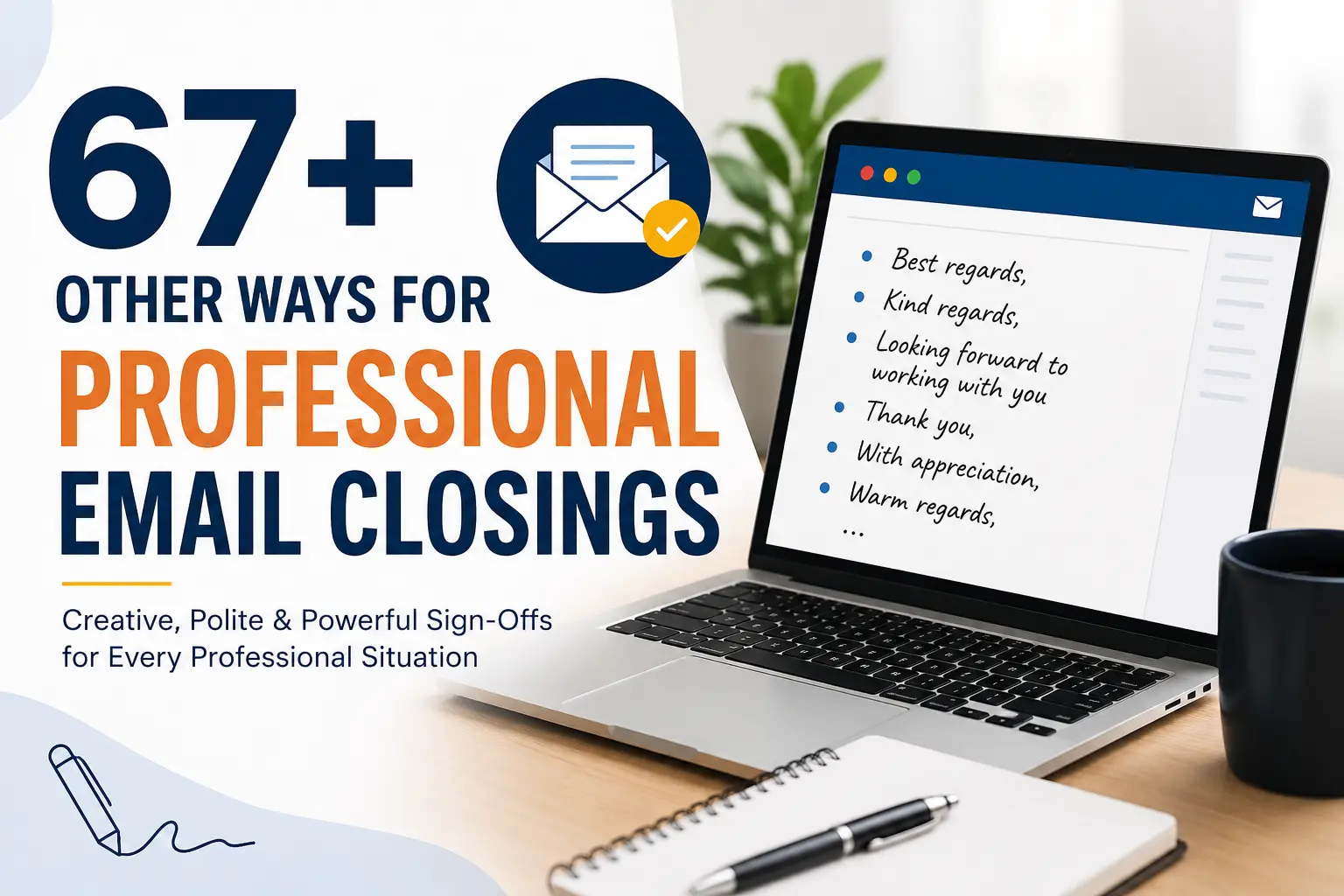
The right email closing can turn an ordinary message into a polished and memorable professional exchange. Whether you are communicating with a client, colleague, manager, recruiter, or business partner, your final words influence how your message is received. Professional email closings are more than simple sign offs. They can communicate appreciation, confidence, openness, warmth, respect, or enthusiasm while reinforcing your professional image.
Using different 67+ other ways for professional email closings alternatives helps you avoid repetitive expressions such as “Best regards” or “Sincerely” in every message. A thoughtfully chosen closing can make your communication feel more natural and personal without sacrificing professionalism. The key is matching the closing to your relationship with the recipient, the purpose of your message, and the overall tone of your email. The following alternatives give you practical options for creating polished, engaging, and context appropriate email endings.
Section 1: What Does 67+ Other Ways for Professional Email Closings Mean?
“Professional email closings” refers to the words or phrases used at the end of an email before your name or signature. Common examples include “Best regards,” “Kind regards,” “Sincerely,” and “Thank you.”
The phrase 67+ other ways for professional email closings refers to a collection of alternative expressions that can replace conventional email sign offs. These alternatives allow writers to communicate similar sentiments while adapting their tone to different situations.
A professional closing can sound formal, friendly, appreciative, confident, respectful, or enthusiastic. For example, “I appreciate your time” conveys gratitude, while “Looking forward to our conversation” creates a sense of anticipation. Choosing the right expression makes your email feel intentional rather than formulaic.
Section 2: When to Use Professional Email Closings
Professional email closings can be used in almost any workplace communication, but the best expression depends on context.
Formal Business Emails
Use more traditional closings when communicating with executives, clients, government officials, or people you do not know well.
Example:
Thank you for your consideration. I look forward to hearing from you.
Job Applications
A confident and respectful closing works particularly well when contacting recruiters or hiring managers.
Example:
I appreciate your time and consideration and look forward to discussing the opportunity.
Client Communication
Warm but professional language can strengthen business relationships.
Example:
Thank you for your continued partnership. I look forward to supporting your team.
Internal Workplace Emails
You can use slightly more relaxed closings when writing to colleagues you know well.
Example:
Thanks again for your help. Have a productive afternoon.
Follow Up Emails
Closings that communicate openness and anticipation are useful when you are waiting for a response.
Example:
I look forward to your thoughts and am happy to provide any additional information.
Networking Emails
A friendly closing can help maintain professional relationships.
Example:
It was a pleasure connecting with you. I hope we can stay in touch.
Section 3: Is It Polite or Professional?
Yes. Professional email closings are generally polite and appropriate for business communication. However, not every closing is suitable for every recipient.
For highly formal situations, expressions such as “Sincerely,” “Respectfully,” and “With appreciation” are safe choices. For established professional relationships, “Best,” “Warm regards,” or “Have a great day” may feel more natural.
The most important principle is tone matching. A closing should complement the message rather than feel noticeably more casual or formal than the rest of the email.
For example, “Thank you for your consideration” is appropriate when making a formal request, while “Have a wonderful weekend” is better suited to a friendly workplace exchange.
Section 4: 67+ Other Ways for Professional Email Closings
1. Best regards
Meaning: A courteous expression of goodwill.
Tone: Professional and versatile.
I appreciate your assistance and look forward to speaking with you. Best regards.
Why to use it: This is one of the safest choices for everyday business correspondence.
Purpose and personalization: Ideal when you want professionalism without excessive formality.
2. Kind regards
Meaning: A polite expression of goodwill.
Tone: Warm and professional.
Thank you for your prompt response. Kind regards.
Why to use it: Excellent for clients, colleagues, and professional contacts.
3. Warm regards
Meaning: A friendly expression of respect and goodwill.
Tone: Warm and personable.
It was wonderful speaking with you today. Warm regards.
Why to use it: Works particularly well when you have an established relationship.
4. Sincerely
Meaning: A traditional expression of genuine respect.
Tone: Formal and polished.
Thank you for reviewing my application. Sincerely.
Why to use it: Appropriate for formal business letters, applications, and official correspondence.
5. Yours sincerely
Meaning: A formal closing expressing respect.
Tone: Formal and traditional.
I appreciate your consideration and look forward to your response. Yours sincerely.
Why to use it: Suitable for formal correspondence, especially in British English.
6. With appreciation
Meaning: A direct expression of gratitude.
Tone: Appreciative and professional.
Thank you for your valuable guidance. With appreciation.
Why to use it: Ideal when someone has provided meaningful assistance.
7. With gratitude
Meaning: A sincere expression of thankfulness.
Tone: Warm and appreciative.
Thank you for your continued support. With gratitude.
Why to use it: Particularly effective when expressing genuine appreciation.
8. Thank you
Meaning: A straightforward expression of gratitude.
Tone: Simple and professional.
Thank you for your time and consideration. Thank you.
Why to use it: Best when appreciation is the primary purpose of the closing.
9. Many thanks
Meaning: A stronger expression of appreciation.
Tone: Friendly and professional.
Many thanks for sending the updated documents.
Why to use it: Excellent for routine professional requests and responses.
10. Thanks again
Meaning: A reminder of appreciation.
Tone: Friendly and conversational.
Thanks again for helping us meet the deadline.
Why to use it: Works well when gratitude has already been mentioned in the email.
11. Thank you for your time
Meaning: Appreciation for the recipient’s attention.
Tone: Respectful and professional.
Thank you for your time. I look forward to your feedback.
Why to use it: Particularly useful for meetings, interviews, and requests.
12. Thank you for your consideration
Meaning: Appreciation for reviewing or evaluating something.
Tone: Formal and respectful.
Thank you for your consideration. I look forward to hearing from you.
Why to use it: Excellent for applications, proposals, and formal requests.
13. Thank you for your assistance
Meaning: Appreciation for someone’s help.
Tone: Professional and courteous.
Thank you for your assistance with this matter.
Why to use it: Suitable for customer service, administrative, and workplace communication.
14. Thank you for your continued support
Meaning: Appreciation for ongoing assistance or cooperation.
Tone: Warm and professional.
Thank you for your continued support throughout this project.
Why to use it: Ideal for long term professional relationships.
15. I appreciate your help
Meaning: Recognition of someone’s contribution.
Tone: Friendly and sincere.
I appreciate your help in resolving this issue.
Why to use it: Natural for colleagues and professional contacts.
16. I appreciate your time
Meaning: Recognition that the recipient has devoted time to you.
Tone: Respectful and polished.
I appreciate your time and look forward to discussing this further.
Why to use it: Excellent for meetings, interviews, consultations, and requests.
17. I appreciate your consideration
Meaning: Gratitude for someone’s attention or decision making.
Tone: Formal and thoughtful.
I appreciate your consideration of this proposal.
Why to use it: Particularly effective for business proposals and applications.
18. I look forward to hearing from you
Meaning: You anticipate receiving a response.
Tone: Professional and confident.
I look forward to hearing from you regarding the next steps.
Why to use it: A dependable choice for follow ups and requests.
19. I look forward to your response
Meaning: You expect or welcome the recipient’s reply.
Tone: Formal and direct.
I look forward to your response at your earliest convenience.
Why to use it: Useful when a response is necessary.
20. I look forward to your thoughts
Meaning: You welcome the recipient’s opinion.
Tone: Collaborative and professional.
I look forward to your thoughts on the proposed approach.
Why to use it: Perfect for reviews, brainstorming, and decision making.
21. I look forward to your feedback
Meaning: You welcome evaluation or suggestions.
Tone: Professional and collaborative.
I look forward to your feedback on the revised draft.
Why to use it: Ideal when sending work for review.
22. I look forward to working with you
Meaning: You express enthusiasm about future collaboration.
Tone: Positive and professional.
I look forward to working with you on this initiative.
Why to use it: Excellent for new clients, colleagues, and partnerships.
23. Looking forward to connecting
Meaning: You anticipate a future conversation.
Tone: Friendly and professional.
Looking forward to connecting next week.
Why to use it: Particularly useful for networking and introductory emails.
24. Looking forward to our conversation
Meaning: You anticipate speaking with the recipient.
Tone: Warm and professional.
Looking forward to our conversation on Thursday.
Why to use it: Works well before meetings, interviews, and consultations.
25. Looking forward to our collaboration
Meaning: You are enthusiastic about working together.
Tone: Professional and optimistic.
Looking forward to our collaboration and the opportunities ahead.
Why to use it: Ideal for business partnerships and projects.
26. I look forward to staying in touch
Meaning: You want to maintain the relationship.
Tone: Friendly and professional.
It was a pleasure meeting you. I look forward to staying in touch.
Why to use it: Excellent for networking and relationship building.
27. Please let me know if I can assist further
Meaning: You remain available to provide additional help.
Tone: Courteous and service oriented.
Please let me know if I can assist further with the arrangements.
Why to use it: Perfect for customer service and professional support.
28. Please feel free to reach out
Meaning: You invite further communication.
Tone: Friendly and approachable.
Please feel free to reach out if you have any questions.
Why to use it: Useful when you want to make future communication easy.
29. I remain available should you need anything further
Meaning: You are available for additional assistance.
Tone: Formal and polished.
I remain available should you need anything further regarding the proposal.
Why to use it: Particularly suitable for formal business correspondence.
30. At your convenience
Meaning: The recipient can respond when suitable.
Tone: Respectful and considerate.
I would be happy to discuss this further at your convenience.
Why to use it: Helpful when you want to avoid sounding demanding.
31. Wishing you continued success
Meaning: You express positive wishes for the recipient’s future.
Tone: Formal and encouraging.
Wishing you continued success with the new venture.
Why to use it: Great for professional milestones and relationship building.
32. Wishing you all the best
Meaning: A broad expression of goodwill.
Tone: Warm and professional.
Wishing you all the best in your new position.
Why to use it: Suitable for transitions, farewells, and congratulations.
33. All the best
Meaning: A concise expression of goodwill.
Tone: Friendly and professional.
Thank you again for your support. All the best.
Why to use it: Works well in less formal workplace relationships.
34. Best wishes
Meaning: A sincere expression of goodwill.
Tone: Warm and versatile.
Best wishes as you move forward with the project.
Why to use it: A good choice when you want something warmer than a traditional sign off.
35. Warm wishes
Meaning: Friendly goodwill and positive sentiment.
Tone: Warm and personable.
Warm wishes for a successful launch.
Why to use it: Best for friendly professional relationships.
36. With best wishes
Meaning: A polished expression of goodwill.
Tone: Formal and warm.
With best wishes for the upcoming presentation.
Why to use it: Suitable for professional messages involving milestones or transitions.
37. With warmest regards
Meaning: A particularly warm expression of respect.
Tone: Warm and personable.
Thank you for your continued partnership. With warmest regards.
Why to use it: Best reserved for established relationships where warmth is appropriate.
38. With respect
Meaning: An expression of professional regard.
Tone: Formal and respectful.
Thank you for considering my perspective. With respect.
Why to use it: Useful when discussing sensitive or important matters.
39. Respectfully
Meaning: A direct expression of respect.
Tone: Formal and authoritative.
I appreciate your consideration of this request. Respectfully.
Why to use it: Appropriate for official, sensitive, or hierarchical correspondence.
40. With sincere thanks
Meaning: A genuine expression of gratitude.
Tone: Formal and appreciative.
With sincere thanks for your valuable assistance.
Why to use it: Effective when someone’s support deserves special recognition.
41. With thanks
Meaning: A concise expression of appreciation.
Tone: Professional and understated.
With thanks for your prompt attention to this matter.
Why to use it: Suitable for business correspondence where brevity matters.
42. With appreciation for your support
Meaning: Specific recognition of someone’s support.
Tone: Warm and grateful.
With appreciation for your support throughout the transition.
Why to use it: Strong for professional relationships involving ongoing cooperation.
43. With gratitude for your time
Meaning: Appreciation for the attention someone has given.
Tone: Sincere and respectful.
With gratitude for your time and thoughtful feedback.
Why to use it: Particularly suitable for mentors, interviewers, and advisers.
44. Thank you for your continued partnership
Meaning: Recognition of an ongoing business relationship.
Tone: Professional and relationship focused.
Thank you for your continued partnership and trust.
Why to use it: Excellent for clients, suppliers, and strategic partners.
45. Thank you for your cooperation
Meaning: Appreciation for someone’s collaboration.
Tone: Formal and courteous.
Thank you for your cooperation as we complete this process.
Why to use it: Useful for administrative and operational communication.
46. Thank you for your prompt attention
Meaning: Appreciation for quickly addressing an issue.
Tone: Formal and professional.
Thank you for your prompt attention to this request.
Why to use it: Ideal when urgency or timely action matters.
47. Thank you for your understanding
Meaning: Appreciation for patience or acceptance.
Tone: Courteous and empathetic.
Thank you for your understanding regarding the revised timeline.
Why to use it: Useful when explaining delays, changes, or inconveniences.
48. I value your input
Meaning: Recognition of the recipient’s opinion or expertise.
Tone: Collaborative and appreciative.
I value your input and look forward to your recommendations.
Why to use it: Excellent for teamwork and decision making.
49. I value our collaboration
Meaning: Appreciation for working together.
Tone: Professional and relationship oriented.
I value our collaboration and look forward to what we accomplish next.
Why to use it: Great for ongoing partnerships and team relationships.
50. I appreciate the opportunity to connect
Meaning: Gratitude for establishing communication.
Tone: Polished and professional.
I appreciate the opportunity to connect and learn more about your work.
Why to use it: Ideal for networking and introductory conversations.
51. It was a pleasure connecting with you
Meaning: Positive recognition of a recent interaction.
Tone: Warm and professional.
It was a pleasure connecting with you during the conference.
Why to use it: Particularly effective after networking events or meetings.
52. It was a pleasure speaking with you
Meaning: Appreciation for a conversation.
Tone: Friendly and polished.
It was a pleasure speaking with you about the position.
Why to use it: Excellent for interviews, consultations, and business discussions.
53. I hope we can stay in touch
Meaning: A desire to maintain communication.
Tone: Friendly and personable.
I enjoyed our discussion and hope we can stay in touch.
Why to use it: Best for networking and professional relationship building.
54. Until we speak again
Meaning: A warm expression anticipating future communication.
Tone: Friendly and polished.
Thank you again for your time. Until we speak again.
Why to use it: Useful when another conversation is likely.
55. Have a productive day
Meaning: A positive wish for the recipient’s day.
Tone: Professional and encouraging.
Thank you for your assistance. Have a productive day.
Why to use it: A practical alternative for routine workplace communication.
56. Have a wonderful day
Meaning: A friendly positive wish.
Tone: Warm and approachable.
Thank you for getting back to me. Have a wonderful day.
Why to use it: Suitable for friendly professional communication.
57. Have a great week
Meaning: A positive wish for the coming week.
Tone: Friendly and conversational.
Thanks again for your help. Have a great week.
Why to use it: Particularly natural for emails sent near the beginning of a workweek.
58. Enjoy your weekend
Meaning: A friendly wish for someone’s weekend.
Tone: Casual and warm.
Thank you for your help this week. Enjoy your weekend.
Why to use it: Best for colleagues and established professional contacts.
59. Wishing you a successful week ahead
Meaning: A positive wish for future productivity.
Tone: Professional and motivational.
Thank you for your collaboration. Wishing you a successful week ahead.
Why to use it: Adds encouragement without becoming overly informal.
60. Wishing you a successful meeting
Meaning: A positive wish before an important meeting.
Tone: Professional and supportive.
Thank you for the preparation. Wishing you a successful meeting.
Why to use it: Useful when communicating shortly before presentations or meetings.
61. Wishing you continued growth
Meaning: A positive wish for professional or organizational development.
Tone: Motivational and professional.
Congratulations on the expansion. Wishing you continued growth.
Why to use it: Particularly effective for business milestones and entrepreneurial communication.
62. Here’s to continued success
Meaning: An optimistic expression celebrating future achievements.
Tone: Positive and personable.
Thank you for an excellent partnership. Here’s to continued success.
Why to use it: Best for established business relationships and celebrations.
63. To your continued success
Meaning: A formal wish for future achievement.
Tone: Professional and encouraging.
Thank you for the opportunity to collaborate. To your continued success.
Why to use it: Works particularly well in congratulatory or partnership focused emails.
64. Thank you for moving this forward
Meaning: Appreciation for helping advance a project or process.
Tone: Collaborative and professional.
Thank you for moving this forward so efficiently.
Why to use it: Excellent for project management and teamwork.
65. Thank you for keeping me updated
Meaning: Appreciation for receiving ongoing information.
Tone: Friendly and professional.
Thank you for keeping me updated throughout the process.
Why to use it: Ideal for project updates, applications, and administrative matters.
66. I appreciate the update
Meaning: Recognition of useful information.
Tone: Concise and professional.
I appreciate the update and will review the information shortly.
Why to use it: Perfect for brief workplace responses.
67. I appreciate your prompt response
Meaning: Gratitude for a quick reply.
Tone: Professional and courteous.
I appreciate your prompt response and will proceed accordingly.
Why to use it: Excellent when acknowledging timely communication.
68. Please keep me posted
Meaning: A request to continue providing updates.
Tone: Friendly and conversational.
Please keep me posted as the project progresses.
Why to use it: Best for colleagues and established professional contacts.
69. I remain at your disposal
Meaning: You are available whenever further assistance is required.
Tone: Highly formal and polished.
I remain at your disposal should you require any additional information.
Why to use it: Appropriate for formal business, legal, diplomatic, or executive correspondence.
70. I am happy to discuss this further
Meaning: You are open to continuing the conversation.
Tone: Professional and approachable.
I am happy to discuss this further whenever convenient.
Why to use it: Useful when the subject may require clarification or additional discussion.
71. I welcome your questions
Meaning: You invite the recipient to ask for clarification.
Tone: Open and professional.
I welcome your questions and would be pleased to clarify any details.
Why to use it: Excellent for proposals, presentations, and instructional communication.
72. I welcome the opportunity to continue our discussion
Meaning: You are interested in further communication.
Tone: Formal and enthusiastic.
I welcome the opportunity to continue our discussion at a convenient time.
Why to use it: Strong for business development, interviews, and networking.
73. Thank you for considering this opportunity
Meaning: Appreciation for someone’s evaluation of an opportunity.
Tone: Formal and respectful.
Thank you for considering this opportunity. I look forward to your thoughts.
Why to use it: Suitable for proposals, partnerships, and professional applications.
74. I look forward to what comes next
Meaning: Optimism about future developments.
Tone: Positive and forward looking.
Thank you for the productive discussion. I look forward to what comes next.
Why to use it: Adds energy to emails involving new projects or collaborations.
75. Thank you again for your partnership
Meaning: Specific appreciation for an ongoing professional relationship.
Tone: Warm and business focused.
Thank you again for your partnership and continued confidence in our team.
Why to use it: Particularly effective in client relationship emails.
Conclusion
A strong professional email closing does more than signal that your message has ended. It reinforces your tone, communicates respect, and can strengthen your relationship with the recipient. From traditional expressions such as “Sincerely” and “Best regards” to warmer alternatives such as “I appreciate your time” and “Wishing you continued success,” the right closing depends on your audience and purpose. These 67+ other ways for professional email closings alternatives give you the flexibility to make everyday correspondence more polished and engaging. Experiment with different expressions naturally, but always prioritize clarity, authenticity, and context.
Discover more.
let me know if i can be of further assistance synonyms