

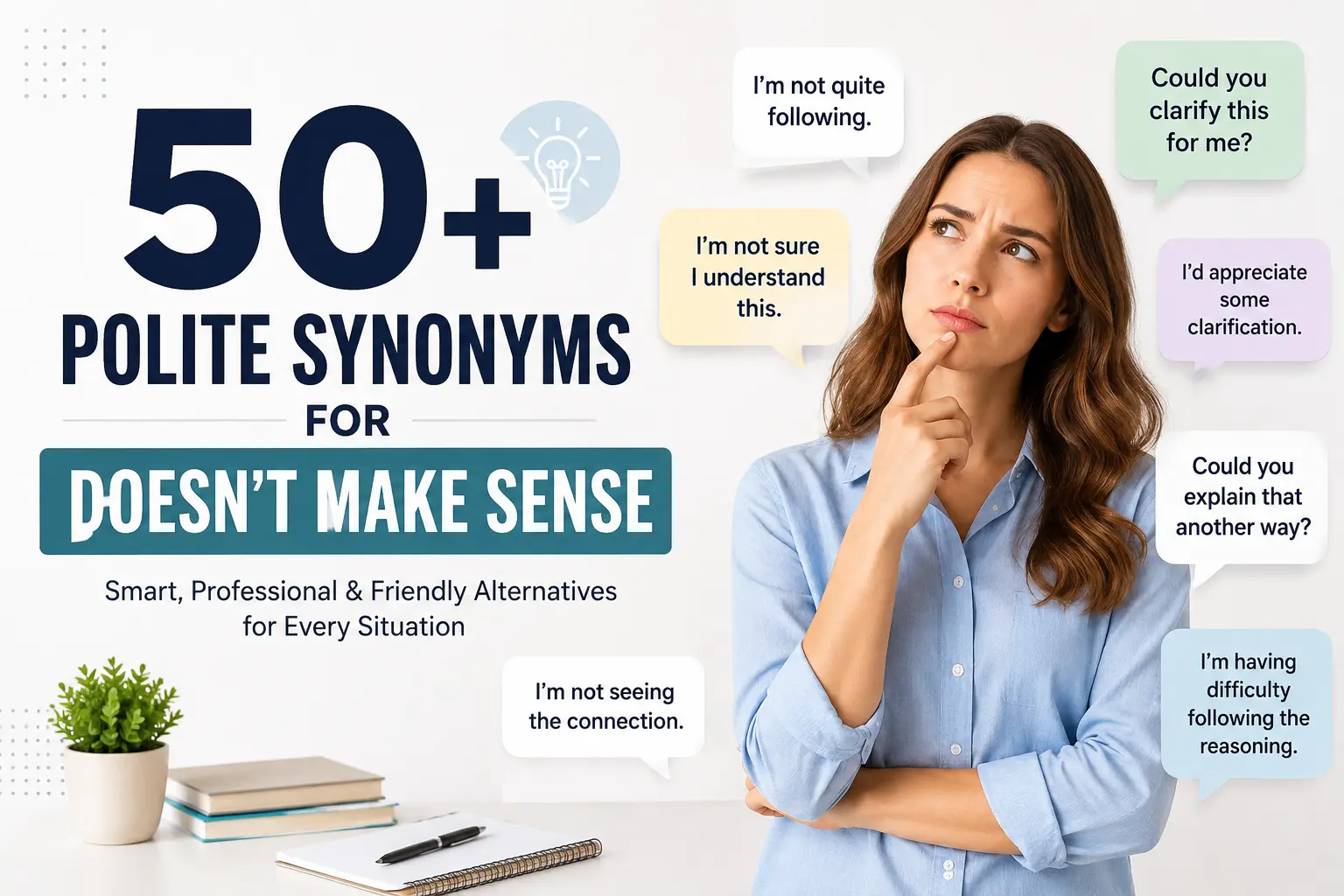
Clear communication is not only about choosing the right words but also about knowing how to express disagreement or confusion without sounding dismissive. The phrase “doesn’t make sense” is common, but in professional conversations it can sometimes sound blunt, critical, or unintentionally negative. Fortunately, there are many polite synonyms for “doesn’t make sense” that allow you to communicate the same idea with greater tact and clarity. Whether you are writing an email, discussing a project, giving feedback, or having a casual conversation, the right alternative can make your message more constructive. Using varied expressions also makes communication feel more natural and personal. In this guide, you will discover 50+ thoughtful alternatives, along with meanings, tones, examples, and practical explanations to help you choose the perfect expression for every situation.
Section 1: What Does “Doesn’t Make Sense” Mean?
“Doesn’t make sense” generally means that something is difficult to understand, unclear, inconsistent, illogical, or not reasonable based on the information available.
For example, if someone says, “The numbers don’t make sense,” they may mean that the figures appear inconsistent. If someone says, “Your explanation doesn’t make sense,” the statement may suggest that the explanation is confusing or difficult to follow.
The expression can be neutral in casual conversation, but its emotional tone depends heavily on context. When directed at another person’s idea, explanation, or decision, it can sound dismissive or critical.
In professional communication, softer alternatives are often preferable because they focus on the issue rather than criticizing the person. Expressions such as “I may need some clarification” or “I’m having difficulty following the reasoning” invite discussion rather than shutting it down.
Section 2: When to Use It
The phrase “doesn’t make sense” and its alternatives can be used in many situations, but the best wording depends on your audience and purpose.
In professional emails
When you need clarification, a softer expression can maintain a respectful tone.
“I’m having some difficulty understanding how these figures were calculated.”
In workplace discussions
Use constructive language when questioning a colleague’s reasoning.
“Could we revisit this approach? I’m not sure the reasoning fully aligns with our objectives.”
In academic writing
Formal expressions are more appropriate when discussing inconsistencies or weaknesses.
“The argument appears difficult to reconcile with the evidence presented.”
In casual conversations
Friendly alternatives can communicate confusion without sounding harsh.
“I’m not quite following what you mean.”
In feedback
Constructive wording is particularly useful when reviewing someone’s work.
“This section could benefit from a little more explanation.”
In presentations or meetings
Professional alternatives can help you raise concerns diplomatically.
“Could you walk us through that part again? I’d like to better understand the connection.”
Section 3: Is It Polite or Professional?
“Doesn’t make sense” is not inherently rude, but it can sound blunt depending on how and where it is used. Saying “Your idea doesn’t make sense” may make the listener feel personally criticized, even if your intention is simply to express confusion.
In professional settings, it is usually better to separate the person from the problem. Instead of saying, “This doesn’t make sense,” you might say, “I’m having trouble following the reasoning” or “Could you clarify this point?”
Polite alternatives are especially valuable in emails, performance feedback, client communication, business meetings, and academic discussions. They communicate uncertainty or disagreement while leaving room for collaboration.
For casual conversations with friends or family, “I don’t quite understand” or “I’m not following” can sound natural and friendly.
Section 4: 50+ Polite Synonyms for “Doesn’t Make Sense”
1. I’m not quite following
Meaning: You are having difficulty understanding the explanation or idea.
Tone: Friendly and conversational.
“I’m not quite following how these two figures relate to each other.”
Short Explanation: Use this when you want to admit confusion without criticizing the speaker.
Purpose and Personalization: It works especially well in meetings and informal professional conversations.
2. I’m having trouble understanding this
Meaning: The information is difficult for you to understand.
Tone: Polite and neutral.
“I’m having trouble understanding this section of the proposal.”
Short Explanation: This focuses on your understanding rather than suggesting that the other person’s work is wrong.
3. Could you clarify this for me?
Meaning: You are asking someone to explain something more clearly.
Tone: Professional and respectful.
“Could you clarify this part of the agreement for me?”
Short Explanation: This is one of the safest choices for workplace emails and discussions.
4. I’m not sure I understand
Meaning: You are uncertain about the meaning or reasoning.
Tone: Gentle and diplomatic.
“I’m not sure I understand how this change will improve the process.”
Short Explanation: It expresses uncertainty without making a negative judgment.
5. I’m not seeing the connection
Meaning: You cannot identify how two ideas or facts are related.
Tone: Professional and constructive.
“I’m not seeing the connection between the proposed changes and the final objective.”
Short Explanation: Excellent when questioning logic or relationships between ideas.
6. I’m having difficulty following the reasoning
Meaning: The logic behind an argument is unclear.
Tone: Formal and analytical.
“I’m having difficulty following the reasoning behind this recommendation.”
Short Explanation: Particularly useful in business, academic, and analytical settings.
7. I’d appreciate some clarification
Meaning: You would like more information or explanation.
Tone: Formal and courteous.
“I’d appreciate some clarification regarding the revised timeline.”
Short Explanation: A polished choice for professional emails.
8. Could you explain that another way?
Meaning: You need the information presented differently.
Tone: Friendly and respectful.
“Could you explain that another way so I can make sure I understand?”
Short Explanation: Useful when the issue may be the explanation rather than the underlying idea.
9. I’m not sure how this fits together
Meaning: The individual pieces do not appear connected to you.
Tone: Neutral and collaborative.
“I’m not sure how this fits together with the original strategy.”
Short Explanation: Good for discussing complicated plans or proposals.
10. I may be missing something
Meaning: You acknowledge that you might not have understood all the details.
Tone: Humble and diplomatic.
“I may be missing something, but could you explain why we selected this option?”
Short Explanation: This reduces the risk of sounding confrontational.
11. I’m not entirely clear on this
Meaning: You do not fully understand something.
Tone: Professional and neutral.
“I’m not entirely clear on this requirement.”
Short Explanation: Suitable for emails, meetings, and project discussions.
12. This could use some clarification
Meaning: More explanation would make something easier to understand.
Tone: Polite and constructive.
“This section could use some clarification before we finalize the document.”
Short Explanation: Focuses on improving the information rather than criticizing its creator.
13. I’m struggling to see the logic
Meaning: The reasoning is difficult to understand.
Tone: Direct but still professional.
“I’m struggling to see the logic behind moving the deadline forward.”
Short Explanation: Best when you genuinely need to question the reasoning.
14. I’m not sure the reasoning is clear
Meaning: The logic has not been sufficiently explained.
Tone: Formal and tactful.
“I’m not sure the reasoning is clear from the current presentation.”
Short Explanation: A strong choice for written feedback.
15. The explanation could be clearer
Meaning: The explanation needs additional clarity.
Tone: Constructive and professional.
“The explanation could be clearer for readers who are new to the process.”
Short Explanation: Ideal for editing, reviewing, and giving feedback.
16. I’m having difficulty making sense of this
Meaning: You are struggling to understand the information.
Tone: Polite and neutral.
“I’m having difficulty making sense of these conflicting figures.”
Short Explanation: A softer version of the original expression.
17. I’m not following the point
Meaning: You do not understand the main idea being communicated.
Tone: Casual and respectful.
“I’m not following the point you’re making here.”
Short Explanation: Useful in conversations where you need someone to restate their main idea.
18. Could you provide a little more context?
Meaning: You need additional background information.
Tone: Professional and courteous.
“Could you provide a little more context around this decision?”
Short Explanation: Excellent when something seems confusing because information is missing.
19. I’d like to better understand the rationale
Meaning: You want to know why a decision or approach was chosen.
Tone: Formal and businesslike.
“I’d like to better understand the rationale behind this recommendation.”
Short Explanation: Particularly effective when discussing business decisions.
20. I’m not convinced the approach is clear
Meaning: The method or strategy is not sufficiently understandable.
Tone: Diplomatic and professional.
“I’m not convinced the approach is clear enough for the wider team.”
Short Explanation: Useful when reviewing plans or procedures.
21. There seems to be a gap in the explanation
Meaning: An important part of the reasoning appears to be missing.
Tone: Analytical and professional.
“There seems to be a gap in the explanation between these two stages.”
Short Explanation: Focuses on the missing information rather than blaming someone.
22. Something seems unclear here
Meaning: A particular part of the information is confusing.
Tone: Gentle and neutral.
“Something seems unclear here, particularly regarding the payment terms.”
Short Explanation: A simple option for everyday workplace communication.
23. I’m not sure how to interpret this
Meaning: You are uncertain about the intended meaning.
Tone: Polite and formal.
“I’m not sure how to interpret this clause in the contract.”
Short Explanation: Particularly useful for documents, policies, and written instructions.
24. This point may need further explanation
Meaning: Additional details would improve understanding.
Tone: Formal and constructive.
“This point may need further explanation before the report is circulated.”
Short Explanation: Appropriate for professional reviews and academic feedback.
25. I’d like to revisit this point
Meaning: You want to discuss or reconsider something.
Tone: Diplomatic and professional.
“I’d like to revisit this point before we move forward.”
Short Explanation: Great when something appears questionable but you want to remain collaborative.
26. I’m not sure this fully adds up
Meaning: The information appears inconsistent or incomplete.
Tone: Polite but direct.
“I’m not sure these figures fully add up.”
Short Explanation: Best for discussing numbers, calculations, or inconsistencies.
27. There may be an inconsistency here
Meaning: Two or more pieces of information may not agree.
Tone: Formal and analytical.
“There may be an inconsistency here between the report and the spreadsheet.”
Short Explanation: Excellent for professional and technical contexts.
28. I’m seeing a potential contradiction
Meaning: Two statements or ideas appear to conflict.
Tone: Formal and precise.
“I’m seeing a potential contradiction between these two sections.”
Short Explanation: Use this when identifying conflicting information objectively.
29. The information seems difficult to reconcile
Meaning: Two pieces of information are difficult to make consistent.
Tone: Highly professional and formal.
“The information provided seems difficult to reconcile with the previous report.”
Short Explanation: Particularly effective in business, legal, financial, and academic communication.
30. I’m not sure these points align
Meaning: The ideas or facts do not appear consistent.
Tone: Professional and diplomatic.
“I’m not sure these points align with our current objectives.”
Short Explanation: A polished way to highlight disagreement or inconsistency.
31. The logic could be strengthened
Meaning: The reasoning needs more support or explanation.
Tone: Constructive and professional.
“The logic could be strengthened by including additional evidence.”
Short Explanation: Ideal when giving feedback on writing, presentations, or proposals.
32. The reasoning may need further development
Meaning: The argument requires more detail or support.
Tone: Formal and academic.
“The reasoning may need further development before publication.”
Short Explanation: Useful for essays, reports, research, and professional documents.
33. I’m not fully persuaded by this explanation
Meaning: The explanation has not completely convinced you.
Tone: Respectful and analytical.
“I’m not fully persuaded by this explanation given the available evidence.”
Short Explanation: Use this when disagreeing while maintaining intellectual respect.
34. I’m not sure the argument holds together
Meaning: The different parts of an argument do not seem logically connected.
Tone: Formal and analytical.
“I’m not sure the argument holds together without additional evidence.”
Short Explanation: Appropriate for academic and professional discussions.
35. This seems open to interpretation
Meaning: The information could reasonably be understood in different ways.
Tone: Neutral and diplomatic.
“The wording seems open to interpretation.”
Short Explanation: Useful when unclear wording could create confusion.
36. The message isn’t entirely clear
Meaning: The intended meaning is not completely understandable.
Tone: Polite and professional.
“The message isn’t entirely clear, so I’d recommend revising the final paragraph.”
Short Explanation: A helpful phrase for editing and workplace feedback.
37. The intended meaning is unclear
Meaning: It is difficult to determine what the speaker or writer means.
Tone: Formal and objective.
“The intended meaning is unclear from the current wording.”
Short Explanation: Excellent for reports, policies, and formal documents.
38. I’d like to clarify my understanding
Meaning: You want to confirm that you have understood correctly.
Tone: Professional and courteous.
“I’d like to clarify my understanding before proceeding.”
Short Explanation: Especially useful when discussing instructions or responsibilities.
39. Could we walk through this together?
Meaning: You would like someone to explain the information step by step.
Tone: Friendly and collaborative.
“Could we walk through this together? I want to make sure I haven’t missed anything.”
Short Explanation: Creates a cooperative rather than confrontational atmosphere.
40. I’m having a hard time connecting the dots
Meaning: You cannot see how separate pieces of information relate.
Tone: Friendly and conversational.
“I’m having a hard time connecting the dots between the findings and the recommendation.”
Short Explanation: More informal, making it suitable for friendly workplace discussions.
41. I’m not seeing how this follows
Meaning: You do not understand how one point logically leads to another.
Tone: Professional and analytical.
“I’m not seeing how this conclusion follows from the evidence.”
Short Explanation: Excellent for challenging reasoning respectfully.
42. The conclusion seems difficult to support
Meaning: There may not be enough evidence for the conclusion.
Tone: Formal and objective.
“The conclusion seems difficult to support based on the current data.”
Short Explanation: Useful in analytical, academic, and professional writing.
43. The relationship between these points is unclear
Meaning: The connection between ideas has not been established.
Tone: Formal and precise.
“The relationship between these points is unclear in the current draft.”
Short Explanation: A strong alternative for reports and presentations.
44. I’m not sure this is the clearest way to present it
Meaning: The current presentation may confuse the audience.
Tone: Diplomatic and constructive.
“I’m not sure this is the clearest way to present the findings.”
Short Explanation: Excellent for giving feedback without sounding overly critical.
45. Perhaps we could clarify this section
Meaning: You politely suggest making something easier to understand.
Tone: Courteous and collaborative.
“Perhaps we could clarify this section before sending the proposal to the client.”
Short Explanation: A useful phrase for teamwork and editing.
46. This raises some questions for me
Meaning: Something is unclear or requires further consideration.
Tone: Diplomatic and thoughtful.
“This raises some questions for me regarding the proposed timeline.”
Short Explanation: Ideal when you want to express concern without making a harsh judgment.
47. I have some questions about the reasoning
Meaning: You would like more information about why something was decided.
Tone: Professional and respectful.
“I have some questions about the reasoning behind this recommendation.”
Short Explanation: Encourages a constructive discussion.
48. I’m not sure the conclusion follows from the evidence
Meaning: The evidence does not clearly support the conclusion.
Tone: Academic and analytical.
“I’m not sure the conclusion follows from the evidence presented.”
Short Explanation: Particularly useful in research, essays, and analytical reports.
49. The explanation leaves me with some questions
Meaning: The explanation has not fully resolved your concerns.
Tone: Polite and thoughtful.
“The explanation leaves me with some questions about how the process will work.”
Short Explanation: A tactful way to request further clarification.
50. I think we may need to look at this differently
Meaning: The current interpretation or approach may need reconsideration.
Tone: Diplomatic and collaborative.
“I think we may need to look at this differently given the latest information.”
Short Explanation: Useful when you disagree but want to encourage open discussion.
51. The current approach isn’t entirely clear to me
Meaning: You do not fully understand the method being used.
Tone: Professional and neutral.
“The current approach isn’t entirely clear to me, so could we review the next steps?”
Short Explanation: A strong workplace alternative that keeps the focus on your perspective.
52. I’m finding this difficult to interpret
Meaning: The information is challenging to understand or evaluate.
Tone: Formal and polished.
“I’m finding this difficult to interpret without the supporting documentation.”
Short Explanation: Particularly suitable for formal emails, reports, and technical material.
53. Could we revisit the underlying assumption?
Meaning: You believe an assumption behind an idea may need examination.
Tone: Analytical and sophisticated.
“Could we revisit the underlying assumption before approving the proposal?”
Short Explanation: Excellent when questioning the foundation of an argument rather than simply rejecting it.
54. I’m not sure this is internally consistent
Meaning: Different parts of the information may conflict with one another.
Tone: Formal and technical.
“I’m not sure this is internally consistent with the figures presented earlier.”
Short Explanation: Best suited to reports, data analysis, research, and technical discussions.
55. The rationale could be explained in greater detail
Meaning: More information is needed to understand why something was chosen.
Tone: Formal and respectful.
“The rationale could be explained in greater detail before we finalize the recommendation.”
Short Explanation: A sophisticated choice for professional feedback and executive communication.
56. I’m not sure we have enough information to draw that conclusion
Meaning: The available facts may not adequately support the conclusion.
Tone: Analytical and diplomatic.
“I’m not sure we have enough information to draw that conclusion at this stage.”
Short Explanation: Useful when you want to challenge an assumption without dismissing the entire idea.
57. Could you help me understand the thinking behind this?
Meaning: You want to know the reasoning behind a decision.
Tone: Friendly and respectful.
“Could you help me understand the thinking behind this approach?”
Short Explanation: This phrasing sounds curious rather than critical and works well with colleagues or managers.
58. I’m not sure the proposal is fully aligned
Meaning: The proposal may not correspond with the intended objectives.
Tone: Professional and diplomatic.
“I’m not sure the proposal is fully aligned with our long term priorities.”
Short Explanation: Useful in business strategy, project management, and organizational discussions.
59. There appears to be some ambiguity
Meaning: The information can be interpreted in more than one way.
Tone: Formal and polished.
“There appears to be some ambiguity in the wording of this requirement.”
Short Explanation: A sophisticated alternative for formal communication.
60. I think some additional context would help
Meaning: More background information would make the issue easier to understand.
Tone: Friendly and professional.
“I think some additional context would help us evaluate this recommendation.”
Short Explanation: A highly adaptable phrase for emails, meetings, and collaborative discussions.
Conclusion
Knowing how to replace “doesn’t make sense” with a more thoughtful expression can significantly improve the quality of your communication. Whether you need clarification, want to question an assumption, or are giving constructive feedback, the right wording allows you to express your point without sounding dismissive. Professional phrases such as “I’d appreciate some clarification,” “I’m not seeing the connection,” and “There may be an inconsistency here” create space for productive discussion. The key is to choose an expression that matches your audience, context, and intention. Experiment with these alternatives naturally, and your communication will become clearer, more diplomatic, and more effective.
discover more.
professional ways to say sorry i missed your call